

Age demographics, geo-spatial distribution and marketing
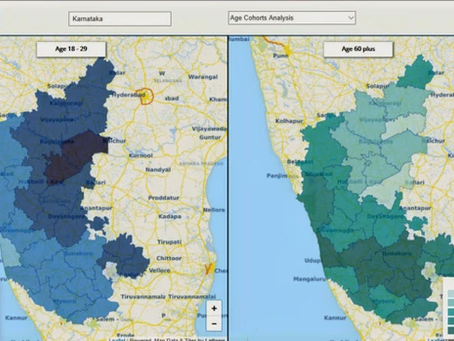
India's median age of 28 is well-known, but the geographic heterogeneity beneath that number is what matters for marketers. Districts and even neighbourhoods vary sharply in their age cohort distribution.
India is a demographically 'young' country — the median age of Indian population is about 28 years, while that of China is 37 years. However, any average invariably misses the layered information beneath that one salient number. In a complex and socio-economically diverse country like ours, the geographic dimension plays a significant role.
Age Demographics Vary Significantly Within a State
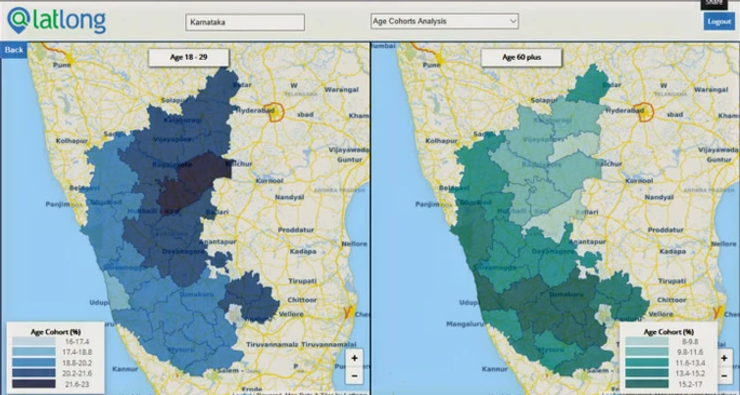
Latlong estimates that the proportion of Karnataka population which is 60+ years old is about 11.9%, while Uttar Pradesh is about 8.6% and Tamil Nadu's is about 13.5%. The 18–29 cohort in Karnataka, Uttar Pradesh and Tamil Nadu is estimated to be about 19.7%, 21.7% and 19.1% respectively.
Even within Karnataka, the picture is striking. Bengaluru has a lower share of 60+ year olds at about 8.9% — substantially lower than Karnataka average. The 60+ cohort has a huge range from Bengaluru's 8.9% to Udupi's 16.7%.
Age Cohorts Vary Even Across a City
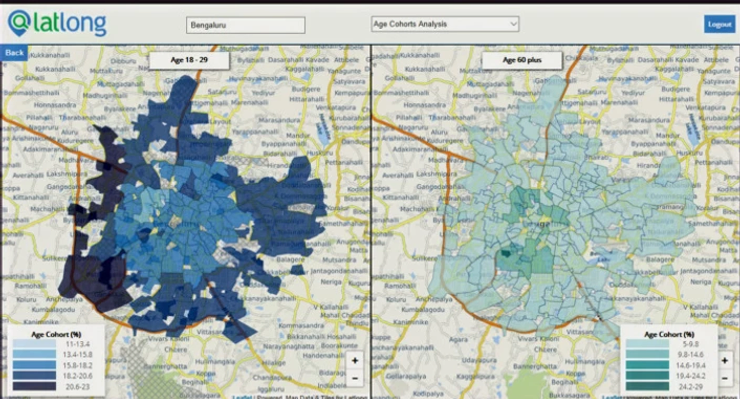
The central part of Bengaluru (old Bengaluru) has a lesser proportion of 18–29 year olds and a much higher proportion of 60+ year olds than the outer areas. Malleswaram has 10.8% 60+ cohort and about 15.3% 18–29, while Kengeri has 8% and 22% of the same cohorts. One of the trends in Jayanagar and Malleswaram is parents living there whose children are typically in another country.
Implications for a Marketer
Vivek Sunder, COO at Swiggy, summarises brand implications in two key takeaways:
- The heterogeneous nature of age cohorts means that consumer profile needs to be truly hyperlocal — not at Karnataka level, but at Jayanagar level or even more hyperlocal.
- What product will get consumed in what locality will vary quite sharply, every few hundred meters. Having the right mix of inventory (or restaurants in the case of Swiggy) becomes very critical.
'Heterogeneity' of geospatial distribution of population is a given — brands need to use geospatial analytics to think and execute with 'hyperlocal' consumers in mind.
Data & Visualisations

Put location to work.
See how latlong.ai products fit your team. Book a 30-minute walkthrough with our solutions team.