

Schools, Enrolment and Teachers: There Aren't Enough Children
A Niti Aayog report showing India closing 94,000 government schools and a drop in enrolment over a decade has set off debate about the state of school education. Our analysis of the same UDISE+ data, layered with Latlong's own demographic estimates, points to a different cause: schools are being consolidated because there simply aren't enough school-age children to fill them.
A Niti Aayog report showing India closing 94,000 government schools & a drop in enrolment over a decade has set off debate about the state of school education. Our analysis of the same UDISE+ data, layered with Latlong's own demographic estimates, points to a different cause: schools are being consolidated because there aren't enough school-age children to fill them.
School education being a foundation for economic progress of a country is a cliché; but a cliché which makes headlines, when there are big numbers involved. A recent report by Niti Aayog, on School Education in India has triggered a huge reaction. The headlines have been grabbed by a reduction of 94,000 'government' schools, between 2014 and 2024 and by about 8% decline in total enrolment in this period. The report, based on UDISE+ 2024-25 and PARAKH data, is quite comprehensive and needs to be reviewed in detail, for conclusions to be drawn.
Our analysis team at Latlong went to the source data to see if the brouhaha is justified. We reviewed the extensive data available in UDISE+ reports and from Latlong's own data on school location and demography. Data for the latest year, 2025-26, is compared with 2018-19, which is a pre-covid year. Choice of the year is to ensure that it had no pandemic effect. Incidentally, 2018-19 had ~35k more schools than 2014-15!
Total Fertility Rate (TFR – average number of children a woman is expected to bear in her lifetime) has been dropping quite sharply for several years. So alongside the school data, we looked at Latlong's own birth estimates across several years to gauge how many children of school-going age actually exist in the population. That number turns out to explain far more than any policy story does.
There aren't enough children
The number of schools in Bharath has decreased, by 84,318, in the 7-year period to 2025-26. Total number of schools steadily decreased from 15.51 lakh in 2018-19 to 14.67 lakh in 2025-26. Net decrease of 5.4%.
Total enrolment during this period has decreased from 26.03 crore to 24.69 crore in 2024-25. The decrease of 1.34 crore is a decline of 5.1%. The decrease in schools and enrolment are fairly in sync. But, which is the cause and which is the effect? Is enrolment dropping because of 'lack of access', due to school closure, as is being argued, by some? Or are both reducing due to the effect of some other factor?
India's fertility rate (TFR) has dropped from 3.2 in 2002 to 2.0 in 2020; a decline of more than a third in eighteen years. Children born in 2002 would be completing their school education in 2019, while those born in 2020 would be joining the school in 2025. We rely on Latlong's demography estimation methodology for population numbers.
Number of live births provides a pointer. This peaked around the turn of the millennium and has been steadily declining. Number of children born in India has dropped from about 2.9 crores in 2001 (peak births) to about 2.3 crores in 2025. A decline of close to 20.6% in 25 years. The 2001 cohort would be leaving school around 2018-19 and the population of school-age children (aged 5-17 years) has to be downhill from there.
Population of school-age children is estimated at 32.53 crores in 2018 and drops to 30.24 crore by 2025. School-age population has dropped by 7.0% in this 7-year period. Latlong demographic estimates suggest school-age cohort is estimated to drop below 30 crore, to 29.87 crore in 2026.

Once we put the decline in enrolment next to the drop in school-age cohort, the picture is clear. Decrease in enrolment is primarily explained by the fact that there aren't enough school-going children. This in turn is driving school closure and consolidation.
There's a silver lining in the numbers too. The share of school-age children actually enrolled in school (let us call this, Enrolment Percentage - EP) has gone up from 80% (2018-19) to 81.6% (2025-26).
Niti Aayog report flags an encouraging trend at the senior end of school. Gross Enrolment Ratio (GER) at higher secondary level (grade 11-12) increased to 58.4% in 2024-25, as compared to 40.1% in 2018-19 and 46.4% in 2014-15. At lower levels, GER has generally been much higher, with 78.7% in secondary level (grade 8-10) in 2024-25.
State-level patterns are genuinely interesting. Bihar presents an interesting case. It grew the number of schools by 7% between 2018-19 and 2025-26, while the enrolment reduced by 17%. This would need much deeper research to understand the dynamics at play in the cities and villages of the state.
Telangana is the obverse of this: schools reduced marginally by 1%, while enrolment increased by 15%.
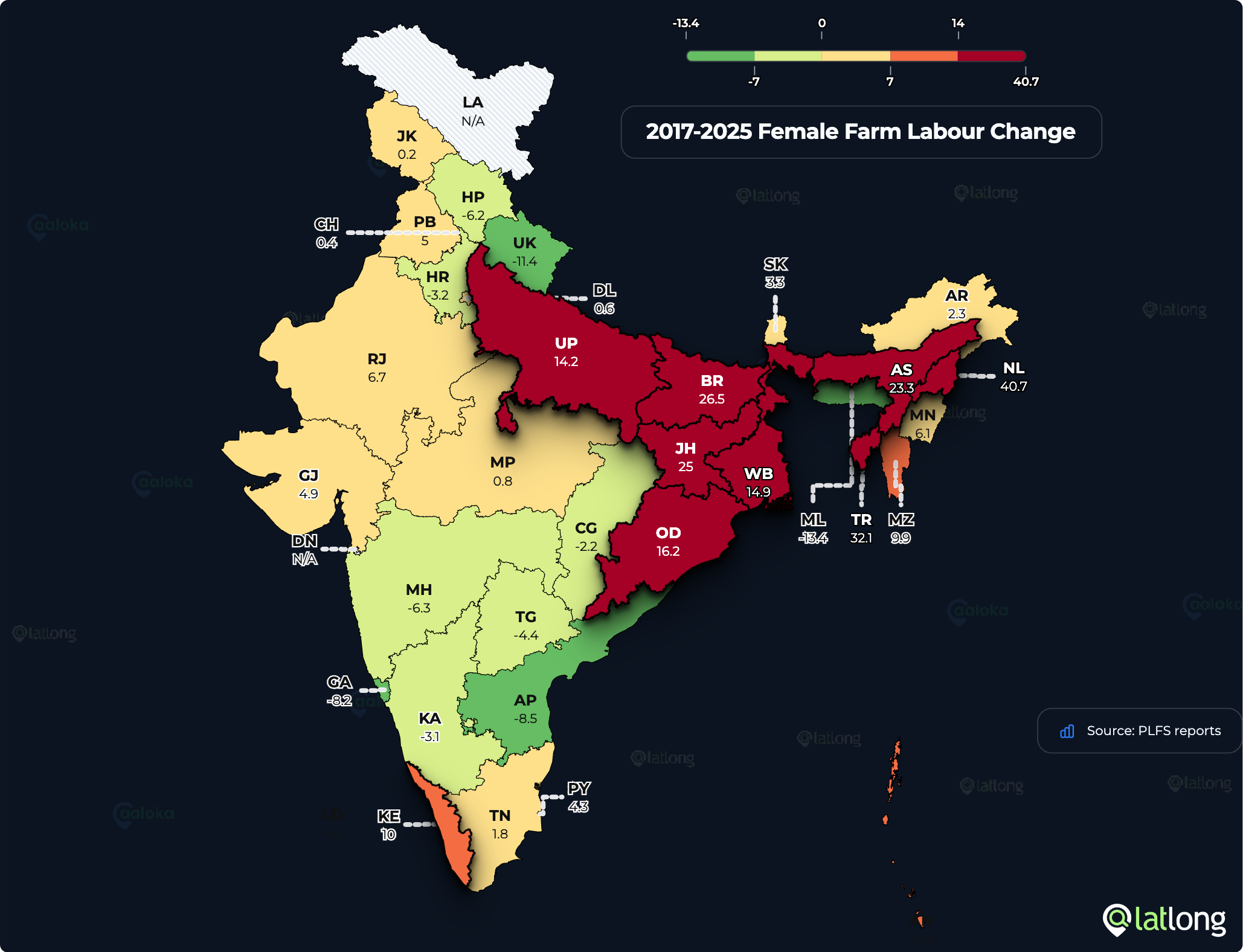
Maps of Bharath are presented, on growth of schools and enrolment between 2018-19 and 2025-26, to make the variances easier to see.


Ghost schools?!
A note on years: the two figures below come directly from the Niti Aayog report and are for 2024-25; one year behind the school and enrolment numbers above, which reflect UDISE+'s newer 2025-26 data.
The Niti Aayog report surfaces two specific, and specifically troubling, symptoms of this mismatch between schools and children: schools with zero enrolment, and schools run by a single teacher.
There were 7,993 schools in the country with ZERO enrolment – 'Ghost' schools. This amounts to 0.54% of the total number of schools. These schools in total had 20,817 teachers employed to teach none.
The problem is heavily concentrated. West Bengal alone has 3,812 ghost schools (4.07% of its total) and Telangana has 2,245 (5.2% of its total). These two states account for 76% of all ghost schools in the country. West Bengal's ghost schools alone carry 17,965 teachers on their rolls.
It's telling that the southern states, where fertility has fallen furthest and fastest, carry a disproportionate share of these ghost schools, tying up infrastructure and teachers that serve no one. At the other end, Uttar Pradesh and Bihar, where TFR remains comparatively higher, show a much lower share of these 'ghost schools'. The pattern tracks the fertility data almost exactly.

Another related challenge is single teacher schools.
1,04,125 schools in 2024-25 were 1-teacher schools; amounting to 7.1% of the total number of schools. There were 33.77 lakh students enrolled in these schools, amounting to 1.1% of the enrolment.
Andhra had the highest number of single teacher schools in the country, at 12,912. This is 21.1% of all schools in the state. Jharkhand is another state with a fifth of schools being run by a single teacher school. Kerala, Nagaland, Odisha and Bihar have less than 2% of the schools taught by a single teacher.
One individual being called upon to impart the entire syllabus from languages to mathematics across many grades of children presents massive challenges. This impacts the learning outcomes in an adverse manner. Additionally, the infrastructure investment is amortised on fewer students, making consolidation an acute need.

Private-sector is carrying more load
A third trend running alongside the first two: private management is taking on a larger share of the burden of educating India's children.
The number of government schools fell from 10,83,747 to 10,05,245 between 2018-19 and 2025-26 – a decline of 7.2%. Over the same period, privately managed (unaided) schools grew from 3,26,228 to 3,41,689, an increase of 4.7%.
Enrolment tells the same story more sharply. Privately managed schools enrolled 9,88,63,908 students in 2025-26, up from 9,21,94,512 in 2018-19 – a 7.2% increase, meaning existing private schools are absorbing more students each, not just adding new schools. Government-run schools, meanwhile, saw enrolment fall from 13,11,13,434 to 11,89,03,585 – a 9.3% drop.
The net effect: 40% of all enrolled students were in privately run schools in 2025-26, up from 35% just seven years earlier. This indicates a growing private-school share of enrolment; the reasons need separate analysis.
Part of the explanation is scale. A private school enrols well over twice as many students, on average, as a government school. The gap widened further between 2018-19 and 2025-26, even as government schools' average enrolment slipped. More students per campus means better economies of scale in staffing, infrastructure and management. This is visible in examples like Karnataka's large, multi-campus chains such as National Public Schools, National Hill View Public School and Delhi Public School.

Meanwhile, teaching capacity has improved sharply
Here's the trend that has received the least attention, and is arguably the most encouraging: even as the number of children and schools has fallen, the number of teachers has gone up substantially.
The country added teachers at a healthy clip between 2018-19 and 2025-26: from 94.3 lakh to 1.03 crore, an increase of 9% over seven years. Uttar Pradesh alone added 3.3 lakh teachers, a 25% increase; Madhya Pradesh and Bihar saw similarly sharp gains, and Telangana added a remarkable 44% more teachers in the same period. West Bengal was the outlier, cutting its teacher headcount by about 5% (roughly 35,000 posts).
The combined effect of more teachers and fewer students is a meaningful improvement in the pupil-teacher ratio (PTR) – from 28 pupils per teacher to 24, over these seven years. This is a huge change.

What this means going forward
The impact of sharp drop in fertility in India, has started showing its impact at the school level. Every sector has to take into account the fact fewer children are being born year on year – from sale of diapers to laptops. This needs to be taken into account in planning, by both government and corporates, as the decrease is quite substantial and varies sharply across regions and districts.
Falling enrolment is primarily a demographic story: India has fewer school-age children, and the decline is driving school consolidation even as teacher capacity improves.
The analysis uses Latlong Maps & Latlong Aaloka.
This article was first published at Bhatta's Musings.

Put location to work.
See how latlong.ai products fit your team. Book a 30-minute walkthrough with our solutions team.