

Men Are Leaving India's Farms; Women Are Joining
Agriculture's share of India's workers has barely moved in seven years. Beneath that flat number, men's farm share fell 5.7 points while women's rose 5.3. More Indian men now work in services than on farms.
Has India's farm exit stalled?
One would think so from the headline numbers. The Periodic Labour Force Survey (PLFS) put agriculture's share of workers at 42.4% in 2017-18. It rose to 44.3% in 2020-21, and settled at 41.5% in 2025. That is a fall of less than a point in seven and a half years, for an economy that has otherwise been through a good deal of change.
The flat line is real, but it hides two opposite flows that very nearly cancel each other out. Separate the numbers for men and women, and the picture changes entirely.
A note on terms: for ease of description, "farm" here means the primary sector (NIC 2008 divisions 01–03), "manufacturing" the secondary sector (divisions 05–43, which also includes mining and construction), and "services" the tertiary sector (divisions 45–99). All figures are PLFS shares of workers by Current Weekly Status, rural and urban combined, from the annual reports for 2017-18, 2020-21 and 2025.
What did the pandemic do?
COVID-19 is the one shock in this series, and it showed up on the farm. Between 2017-18 and 2020-21, agriculture's share of workers rose 1.9 points, from 42.4% to 44.3%, reversing the slow decline before it. Ramesh Chand and Jaspal Singh trace the same jump in PLFS usual-status data to the lockdown quarter of April–June 2020, when non-farm output collapsed and workers moved from cities back to villages (NILERD paper).
What is less noticed is who absorbed that shock. Men's farm share barely moved through the pandemic: 39.4% in 2017-18, 39.1% in 2020-21. Women's jumped from 53.5% to 58.7%. The return to the land was, in these numbers, largely a matter of women taking up farm work, very likely as households fell back on the family plot.
The bump has since unwound. Between 2020-21 and 2025 the overall farm share fell 2.8 points, to below its pre-pandemic level. Men's exit resumed, and faster than before (5.4 points in four years). Women's farm share did not fall back; it held at 58.8%. The pandemic, in short, interrupted men's exit for a while, but it left a lasting mark on women's work.
Who is leaving, and who is joining?
Men are leaving. Their farm share fell from 39.4% to 33.7% between 2017-18 and 2025, and it fell in every one of the 22 major states. Women went the other way: from 53.5% to 58.8%, with most of that rise coming before 2020-21.
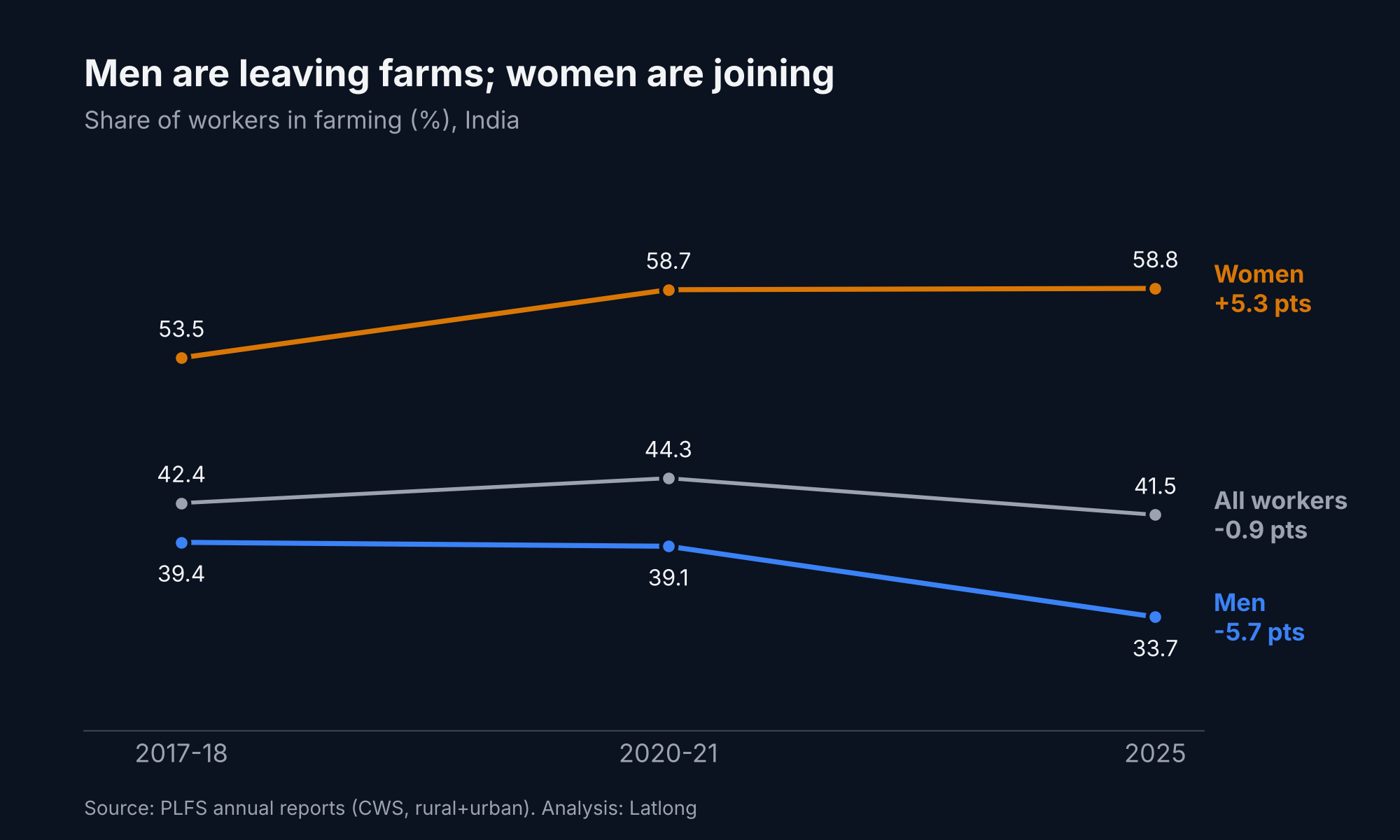
Why, then, does the aggregate barely move? Because women are a much larger part of the workforce than they were. Working back from the male, female and total shares, women made up about 21% of India's workers in 2017-18, 27% in 2020-21 and 31% in 2025. Most of those new women workers went to the farm. Their arrival offsets almost the entire exit of men.
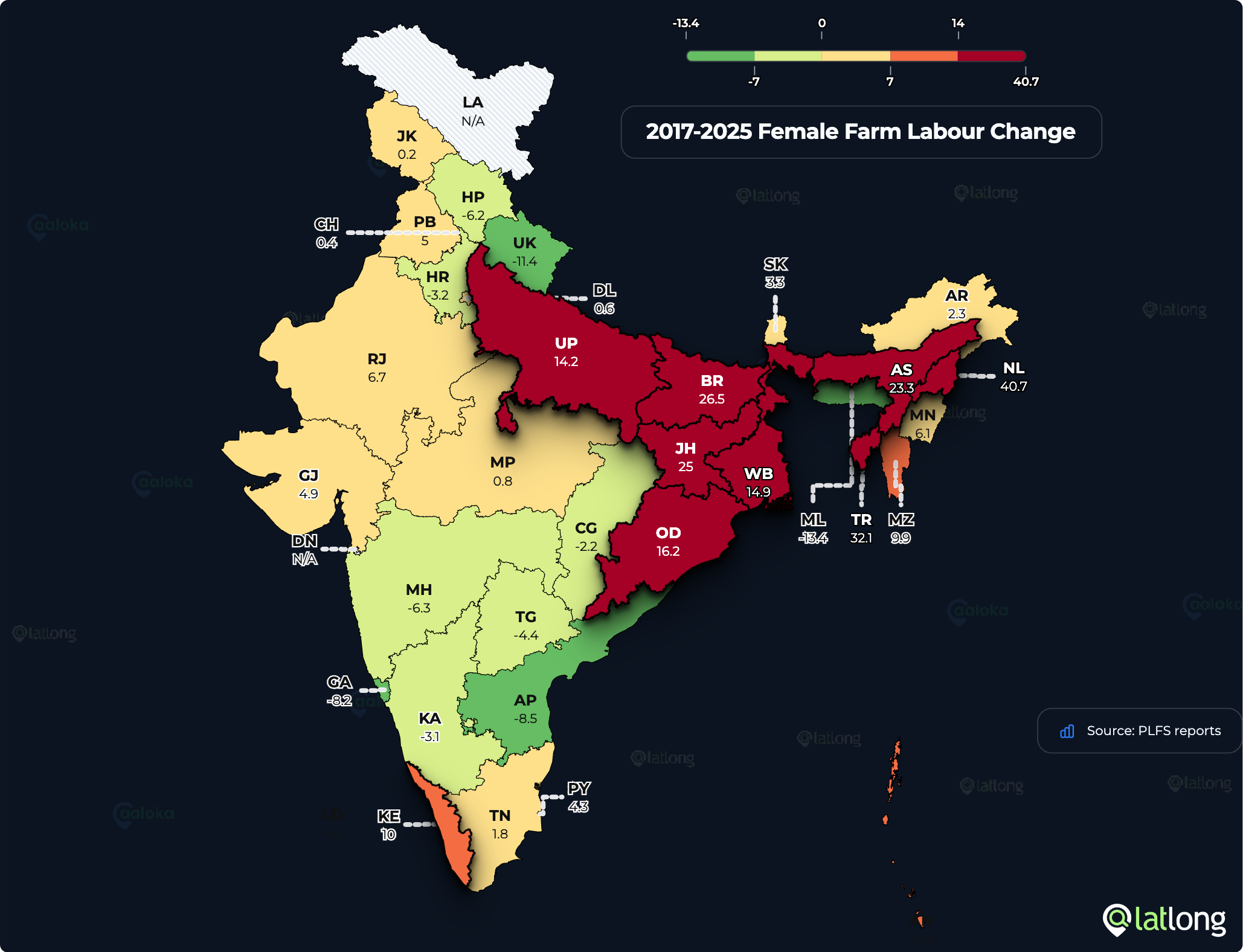
The map makes the geography plain. Women's farm share rose sharply across the east: Bihar (+26.5 points), Jharkhand (+25.0), Assam (+23.3), Odisha (+16.2), West Bengal (+14.9) and Uttar Pradesh (+14.2). These are also the states from which men migrate in the largest numbers. One is tempted to read it as men leaving for the town and women taking over the field.
Fewer men on farms than in services
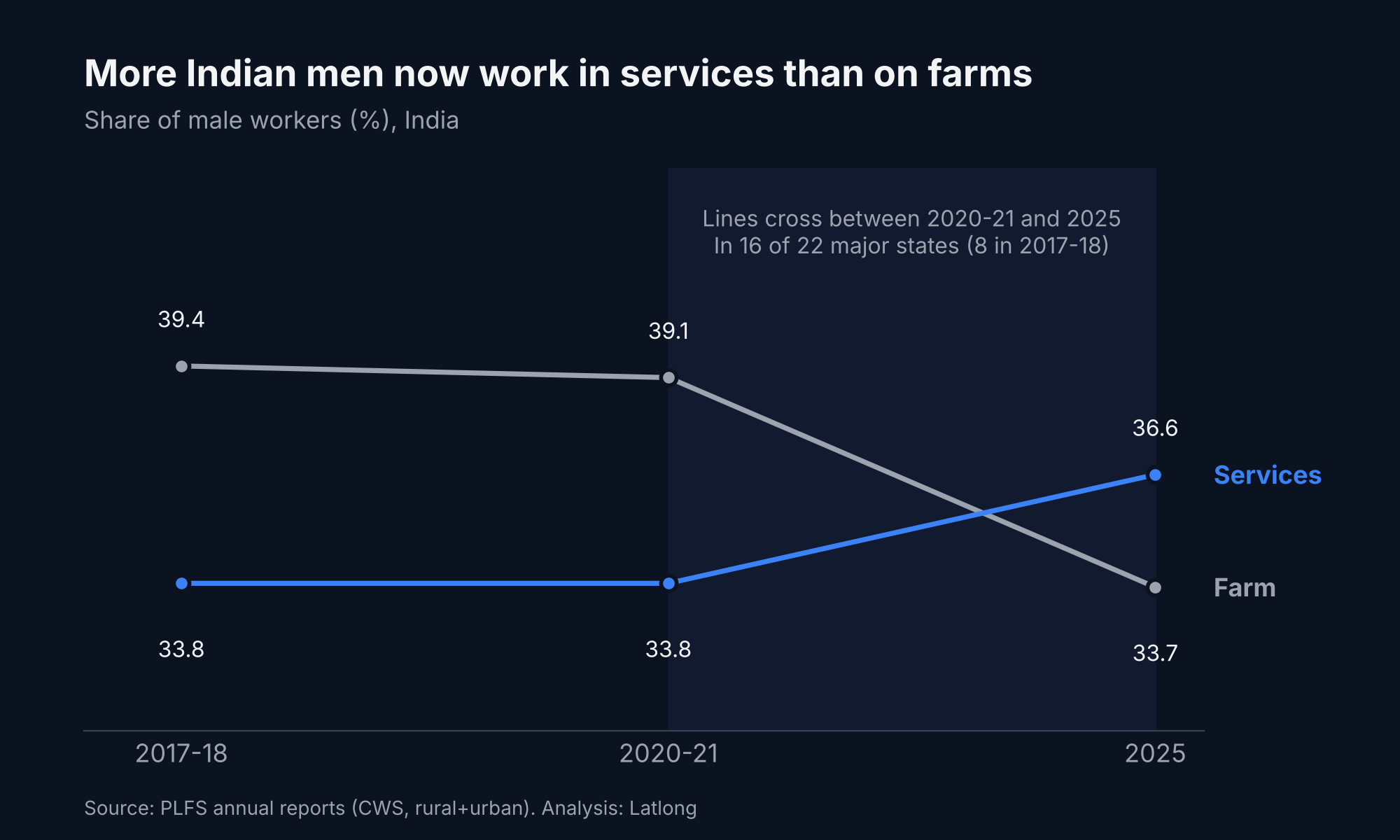
This is the milestone the headline number hides. In 2025, 36.6% of Indian men who work were in services and 33.7% were on farms. In 2017-18 the order was the reverse, 39.4% on farms against 33.8% in services, and it had barely changed by 2020-21. The lines crossed after the pandemic.
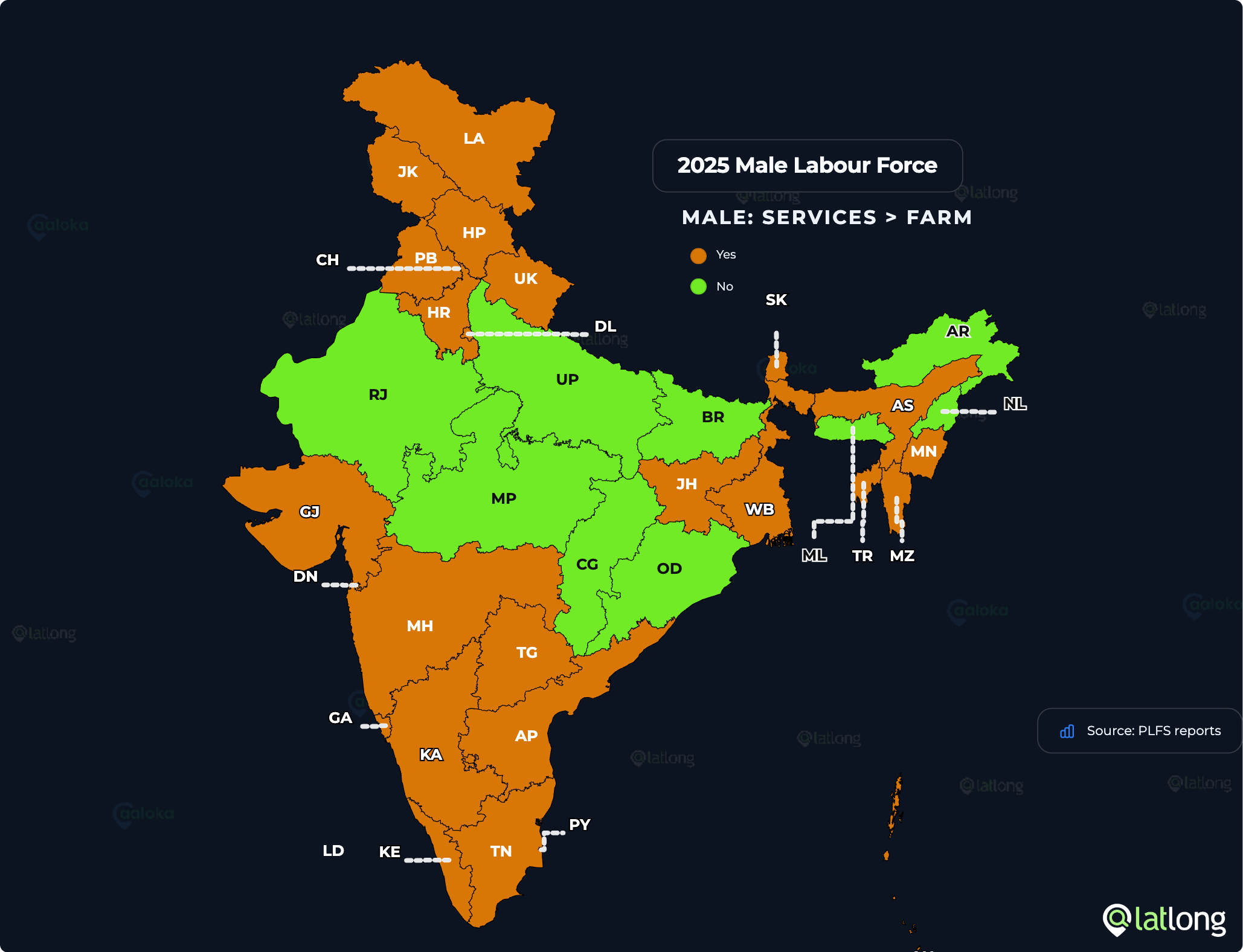
The crossing is no longer a feature of a few urbanised states. Services employ more men than farms in 16 of the 22 major states, up from 8 in 2017-18. The holdouts form a single block: Rajasthan, Madhya Pradesh, Uttar Pradesh, Bihar, Chhattisgarh and Odisha.
Where is the change happening?
Grouping the 22 major states by how their workforce moved between 2017-18 and 2025 gives four clusters:
- Services movers: Maharashtra, Karnataka, Telangana, Tamil Nadu, Haryana and Chhattisgarh. Farm share fell by 3.6–5.8 points in all but Tamil Nadu, where services grew at manufacturing's expense.
- Manufacturing movers: Uttarakhand (farm −9.2, manufacturing +8.0), Andhra Pradesh, Punjab and Assam.
- Status quo: Gujarat, Madhya Pradesh, Uttar Pradesh, Jharkhand, West Bengal and Himachal Pradesh, with the farm share within about two points of where it was.
- Back to the farm: Rajasthan (+6.2), Jammu & Kashmir (+5.1), Bihar (+4.3), Kerala (+3.0) and Odisha (+1.9).
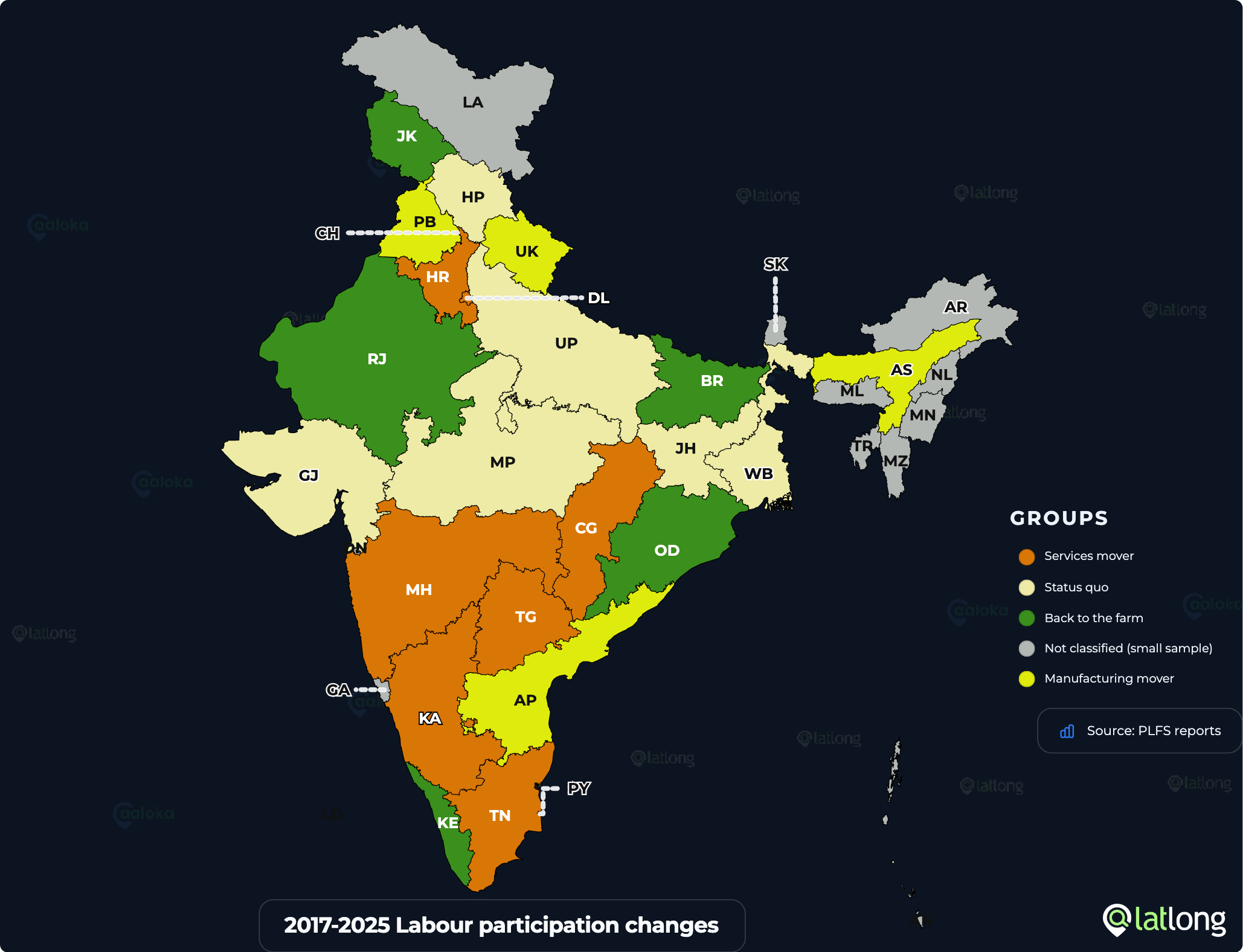
The states are not converging. The spread of farm shares across them was 13.1 points (standard deviation) in 2017-18 and 13.0 in 2025, and states that started with more farm workers did not shed them faster. India's farm exit is running at several speeds at once, and the slowest are the states with the most workers.
What about manufacturing?
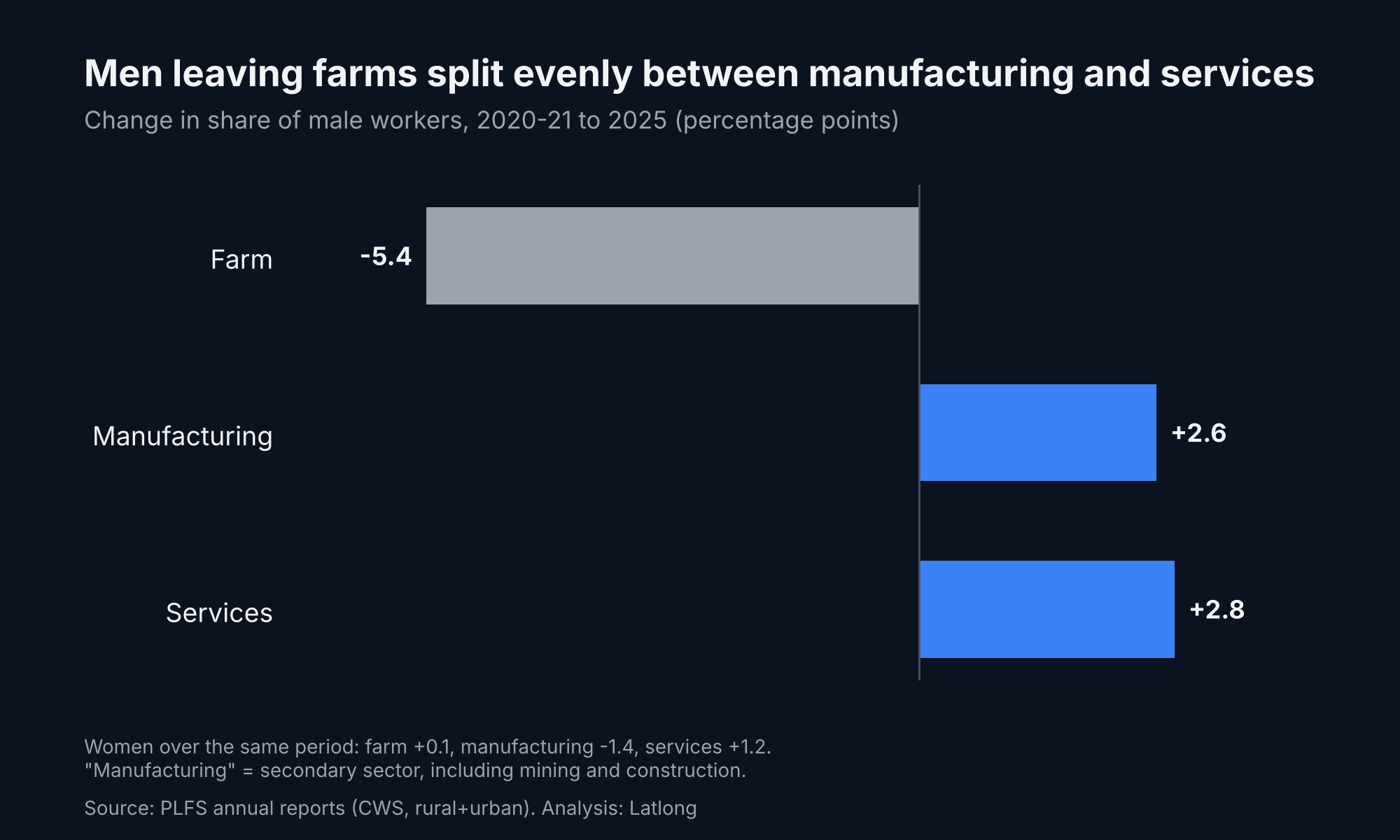
For men, manufacturing is taking about half the farm exit. Between 2020-21 and 2025, men's farm share fell 5.4 points; manufacturing gained 2.6 and services 2.8. Among women, manufacturing's share fell from 17.0% to 15.6%. That is why the overall manufacturing share has barely moved, from 24.4% to 25.3%.
The more interesting finding is where these jobs are. Manufacturing is spreading to states that had little of it. Its share of workers rose from 19.8% to 27.8% in Uttarakhand and from 16.9% to 24.9% in Assam between 2017-18 and 2025. The established industrial states, meanwhile, have stalled or slipped: Tamil Nadu from 34.4% to 31.7%, Kerala from 30.6% to 24.1%, Delhi from 32.6% to 28.0%. Across the major states, the spread of manufacturing shares narrowed from 5.4 points in 2020-21 to 4.2 in 2025. On manufacturing, unlike farming, the states are converging.
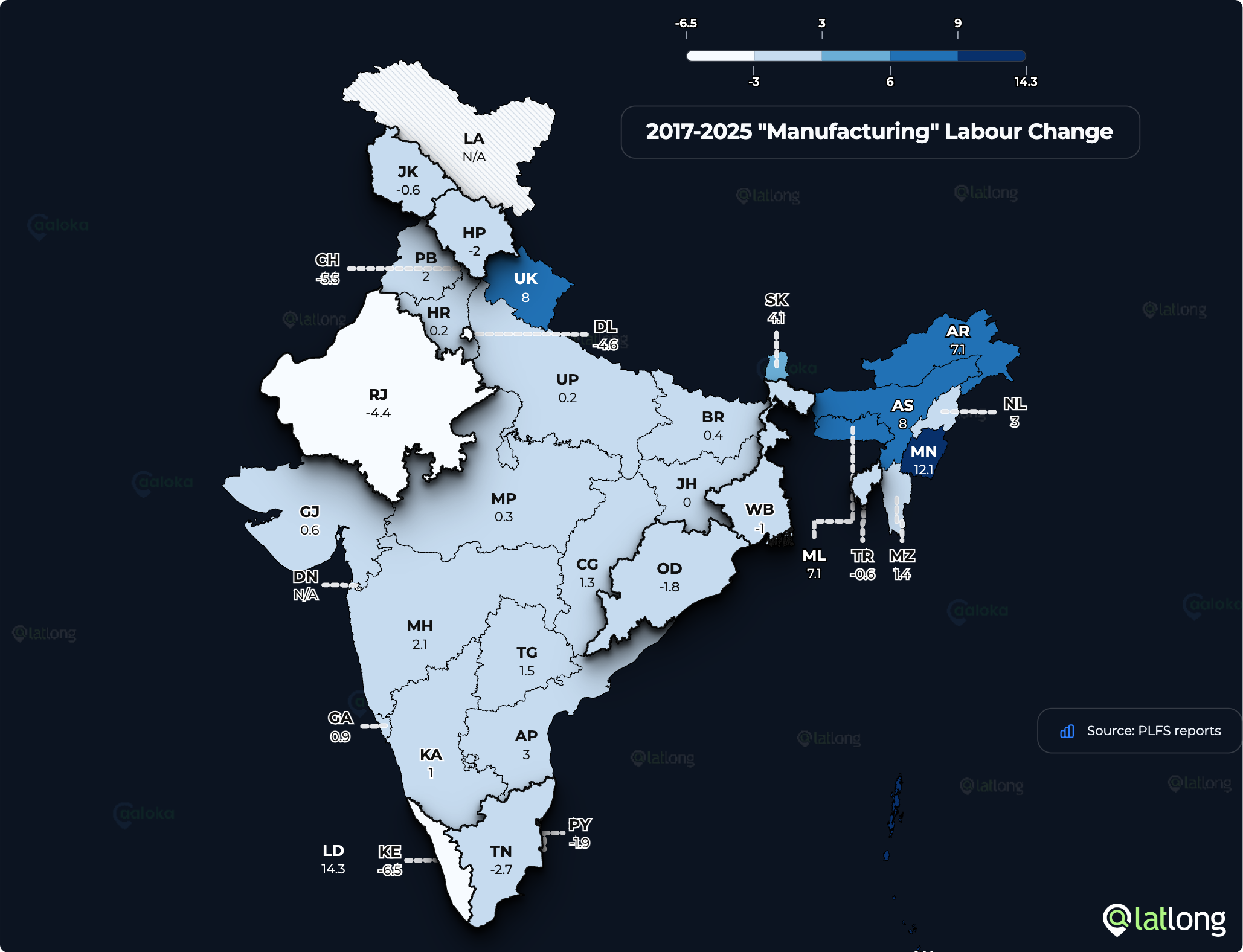
"Manufacturing" here is the whole secondary sector, mining and construction included.
Is 2026 hinting at a faster move?
Possibly, and Chhattisgarh is the state to watch. Its farm share was 58.5% in 2017-18 and 53.3% in 2025. The quarterly bulletins then put it at 43.7% for January–March 2026 and 37.1% for April–June. Over the same months its manufacturing share went from 22.6% (2025) to 32.9%.
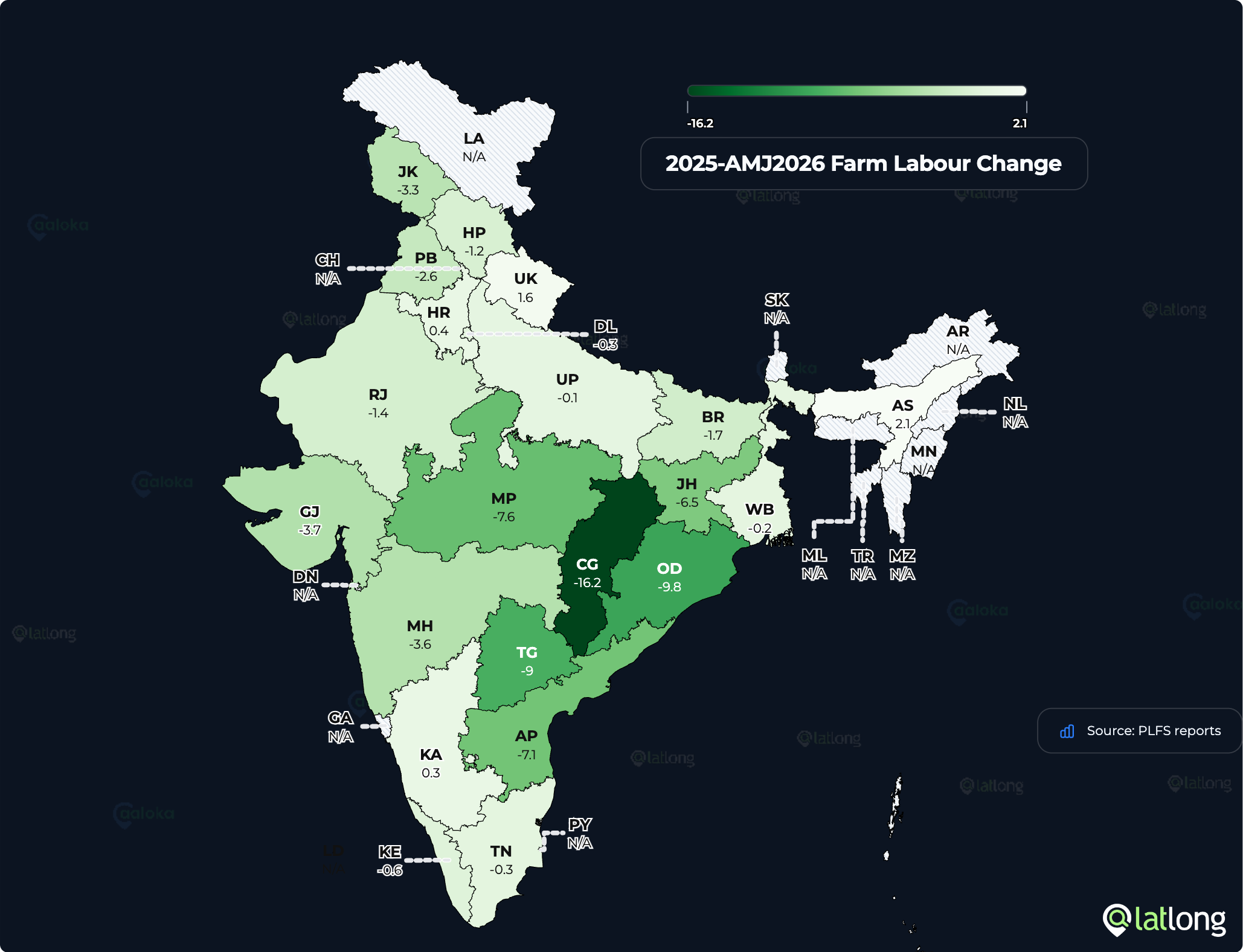
Chhattisgarh is not alone. Between the 2025 annual figures and April–June 2026, farm shares also fell in Odisha (−9.8 points), Telangana (−9.0), Madhya Pradesh (−7.6), Andhra Pradesh (−7.1) and Jharkhand (−6.5). In each, manufacturing rose by roughly 4–10 points. Nationally, manufacturing reached 26.7% of workers, the highest in this series.
April–June is the farm lean season and the busiest months for construction, so part of this is seasonal. If the numbers hold through the rest of 2026 or don't revert sharply back, central India's mineral belt is becoming the new frontier for manufacturing jobs, and the move out of farming is speeding up.
When will farms stop being India's largest employer?
On current trends, in the mid-2030s. In 2025, farms employed 41.5% of workers and services 33.2%, a gap of 8.3 points. A straight line through the totals is misleading here: it mixes men's steady exit with women's arrival. A better estimate projects men and women separately and recombines them.
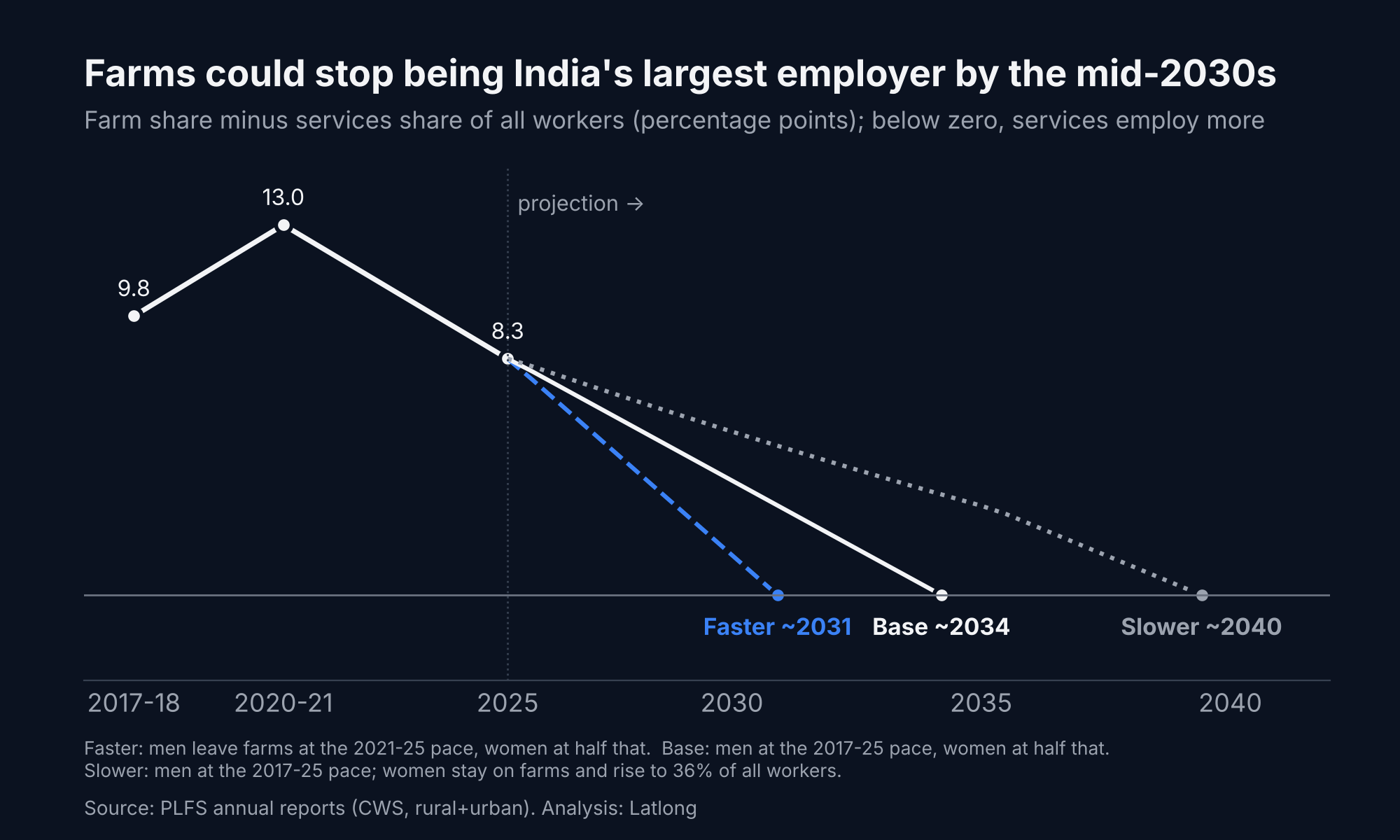
- Faster (~2031): men leave farms at the 2021–25 pace (about 1.2 points a year); women begin leaving at half that pace.
- Base (~2034): men leave at the 2017–25 pace (about 0.8 points a year); women begin leaving at half that pace.
- Slower (~2040): men leave at the 2017–25 pace; women stay on farms and rise to 36% of all workers.
The swing factor is women. If more of them join the workforce but stay on the farm, the date slips towards 2040. If the 2026 quarterly numbers hold, it moves towards 2031. These are rough projections from three annual data points, not forecasts.
Why does it matter?
- Growth. Agriculture produces about 18% of India's gross value added (on the new 2022-23 base) with 41.5% of its workers. Output per worker off the farm is therefore roughly three times that on it. Moving one point of the workforce off the farm at average productivity adds about 1% to output. New workers are less productive than the average, so call it half that. At the post-COVID pace of about 0.6 points a year, the shift alone is worth some 0.3–0.6 percentage points of GDP growth a year. The speed of the shift matters as much as its direction.
- Cities, construction and planning. Men leaving farms for services and building sites need housing, transport and land near where the work is. The demand shows up first at the edges of towns, in the districts that are urbanising fastest.
- Politics. By the mid-2030s, on these trends, more Indian voters will work in services than on farms. Policy built around the farmer and farm-land will be speaking to a shrinking share of the electorate, and to more women than men.
India’s farm exit is underway. Men are on their way out, while women, for now, are staying put in the last four years. This has huge implications for urban planning, economic output and the polity.
Notes / Caveats
- PLFS was redesigned from January 2025, so the 2025 figures are not fully comparable with earlier years.
- The 2026 figures are quarterly and seasonal; April–June is the farm lean season.
- “Manufacturing” includes mining and construction.
- Estimates for small states and UTs are noisy; the groups cover only the 22 major states.
- Women’s share of workers is derived from the published male, female and total shares; PLFS does not report it directly.
- The crossover years are straight-line projections from three annual points, not forecasts.
Sources: PLFS Annual Report 2017-18 · PLFS Annual Report 2020-21 · PLFS Annual Report 2025 · PLFS Quarterly Bulletins, January–March and April–June 2026 · PLFS changes in 2025 · India GVA by sector
This was first published on Substack at: https://pnbhatta.substack.com/p/men-are-leaving-indias-farms-women
More posts

Put location to work.
See how latlong.ai products fit your team. Book a 30-minute walkthrough with our solutions team.