

More Indians Work for Themselves, and in the Cities It Is Starting to Pay
Since 2017-18, more Indians have been working for themselves, and in India's most prosperous cities they now earn more than salaried employees. Meanwhile the salary has lost a bit of its premium, and the casual labourer has had the best real pay rise of anyone.
All maps in this piece were made with Latlong's Aaloka platform, using the Periodic Labour Force Survey data.
The job of last resort
For two generations, the Indian household had a clear order of things. A salaried job, a pakki naukri, was the prize: money on a fixed date, a little security, perhaps a pension. Casual labour was what one did while waiting for something better. And self-employment, the small shop or the tailoring business at home, was often what one did when nothing better came.
Our policy debate still rests on that order. We count the share of workers in regular jobs as the measure of a healthy labour market, and we read a rise in self-employment as a sign of distress.
The Periodic Labour Force Survey (PLFS) for 2017-18 and 2025 suggests that order is being quietly rewritten, and from the bottom up. This data has combined with RBI’s data for Rural & Urban inflation, to calculate real wages.
More Indians work for themselves
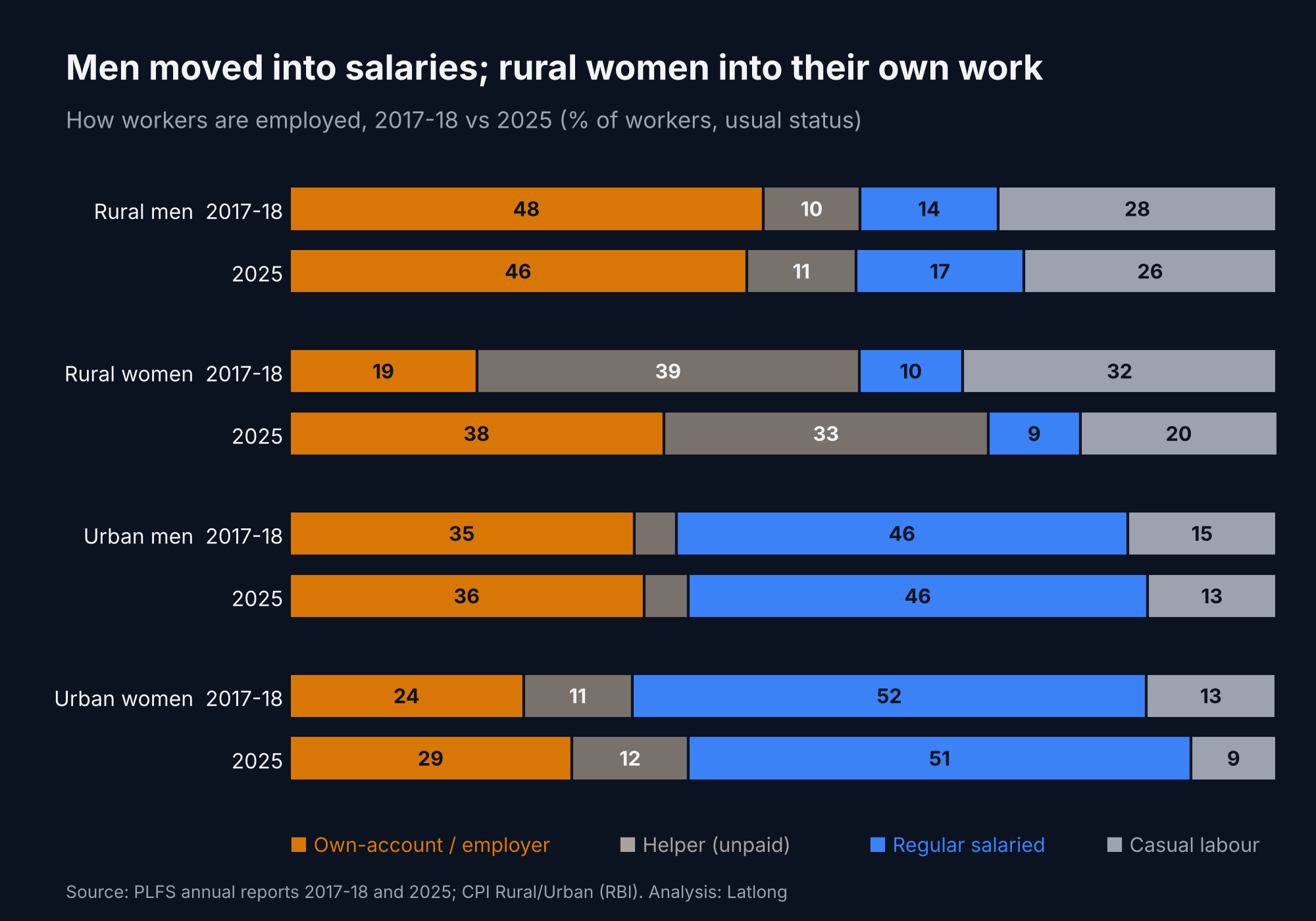
In 2017-18, a little over half of India's workers were self-employed. By 2025 it was 56%. In a decade that was meant to be about formal jobs, more Indians ended up running their own small enterprise: a shop, a field, a stall, a service.
The face of that change is a rural woman. Among rural women who work, the share who are own-account workers or employers doubled, from 19% to 38%. Fewer of them now work as hired day labourers, and fewer as unpaid helpers in a family business.
The map shows where. The heartland and the east moved most: Uttar Pradesh, Bihar, West Bengal, Rajasthan, Jharkhand and Madhya Pradesh each added about 20 points.
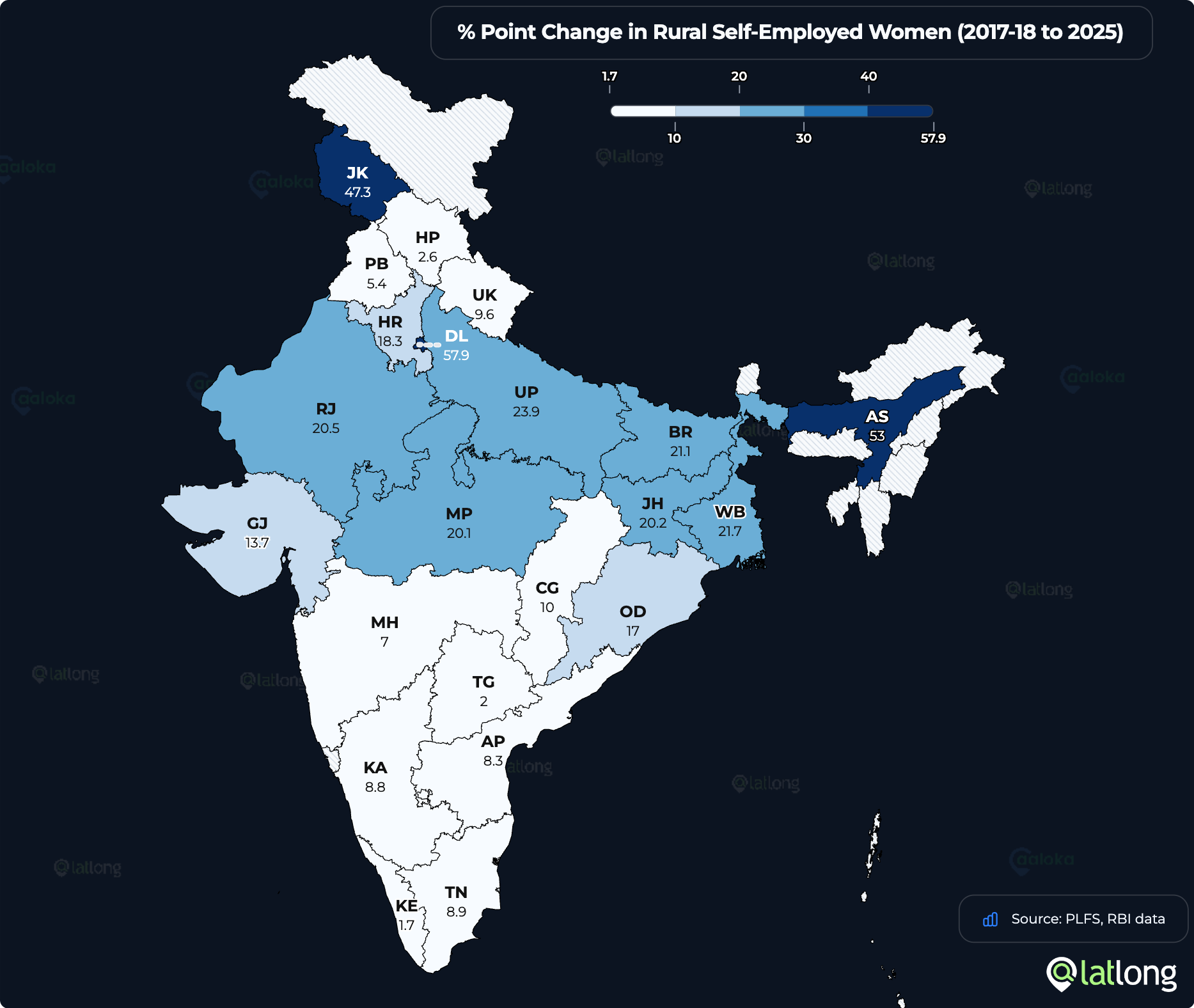
Two cautions belong here. First, this is independence without much income as yet: a rural woman working for herself earned ₹5,540 a month in 2025, about the same in real terms as in 2018. Second, the swings in Assam (+53 points) and Jammu & Kashmir (+47) are too large to be only a change in how women work; some of it is likely a change in how women on family farms are recorded. (Delhi's 57.9 may be more due to small sample and small rural population). The direction is clear; the quantum should be reviewed continuously.
In the cities, it is starting to pay
Now the finding that ought to make one sit up. In urban Gujarat, Maharashtra, Punjab, Himachal Pradesh and Delhi, the average self-employed person now earns more than the average salaried employee. These are earnings after business expenses and not turnover.
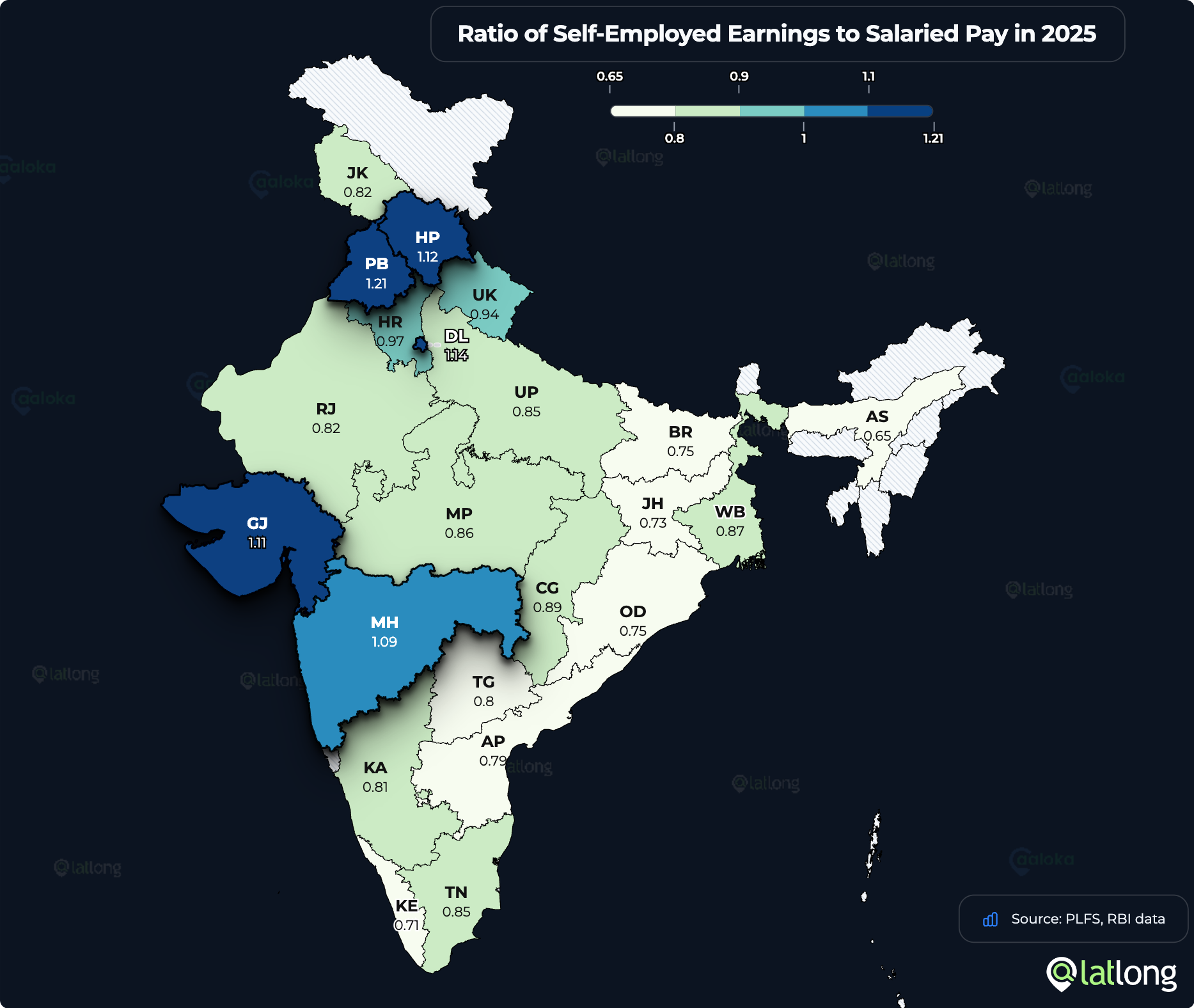
In Maharashtra, Punjab and Himachal Pradesh, the self-employed crossed over within these seven years: Maharashtra went from 0.94 of a salary to 1.09, Punjab from 0.94 to 1.21 and Himachal from 0.80 to 1.12. Gujarat and Delhi were already above parity in 2018 and have stayed there. And it is not because more people set up on their own: Maharashtra's urban own-account share was 28.3% in 2017-18 and 28.4% in 2025. The same proportion of people are simply earning more.
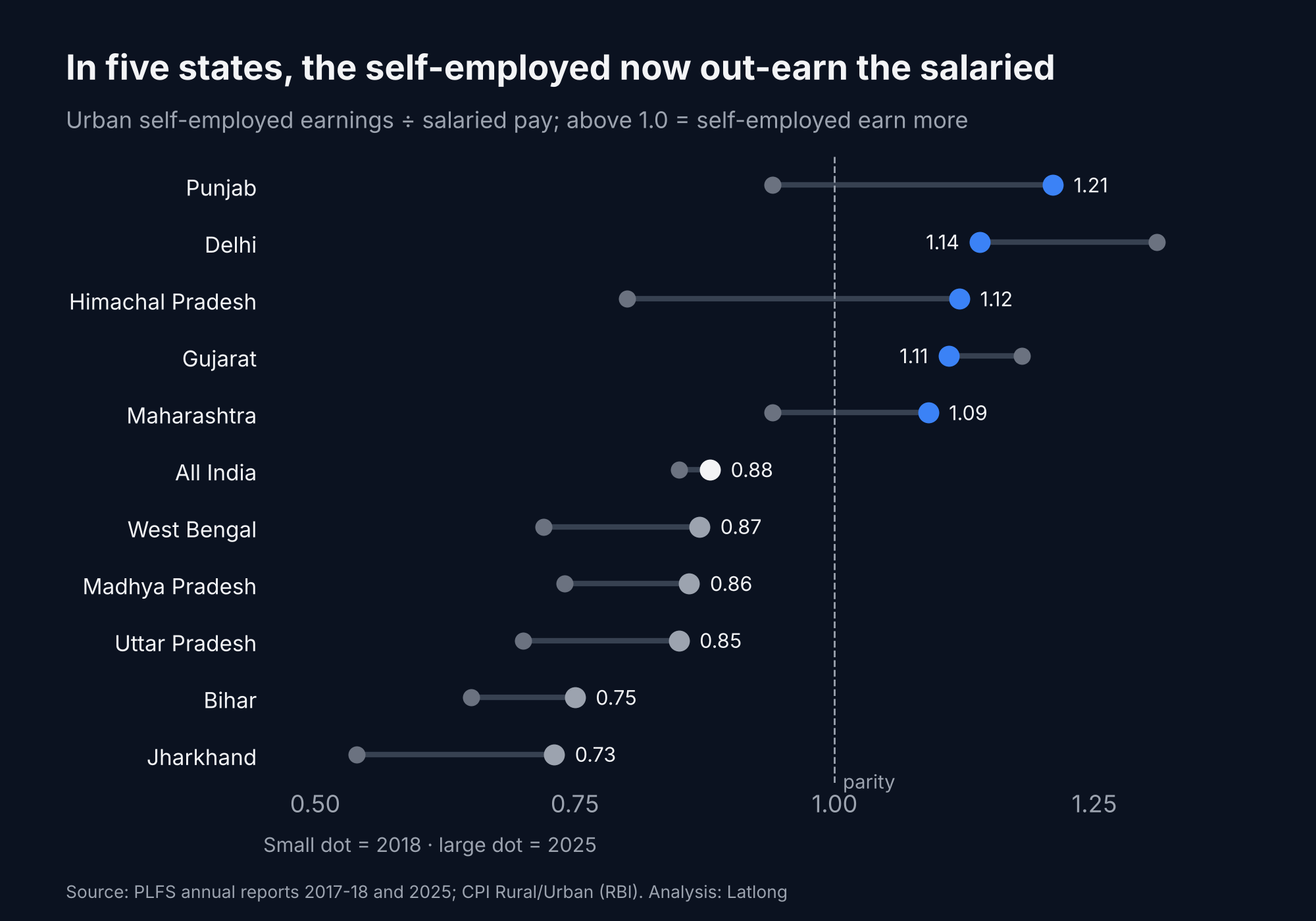
The east, though below parity, is closing the gap fastest: from 0.54 to 0.73 in Jharkhand, and from about 0.7 to 0.85 in Uttar Pradesh and West Bengal.
Is the PM MUDRA loan scheme part of the answer? One cannot prove it from these numbers, but the coincidence is hard to ignore. Since 2015, the Mudra scheme has made 52 crore loans worth ₹32.6 lakh crore. The loans grew larger, from ₹38,000 to over ₹1 lakh on average, and the share of mid-sized Kishor loans rose from 6% to 45%. Lending also tilted towards Bihar and Uttar Pradesh. Bigger loans to growing businesses, in the states where the self-employed closed the gap fastest, is at least suggestive. UPI and the growth of gig workers, belong in the same sentence.
The city pulls ahead
For every kind of worker, urban earnings grew faster than rural earnings between 2018 and 2025, in rupees and after inflation.
A rural salaried worker earned about three-quarters of an urban salary in 2018; by 2025 it was two-thirds. A rural self-employed worker now earns a little more than half of her urban counterpart. Even though the casual worker in Rural areas saw a Real increase in wages, his increase is significantly less than his Urban counterpart.
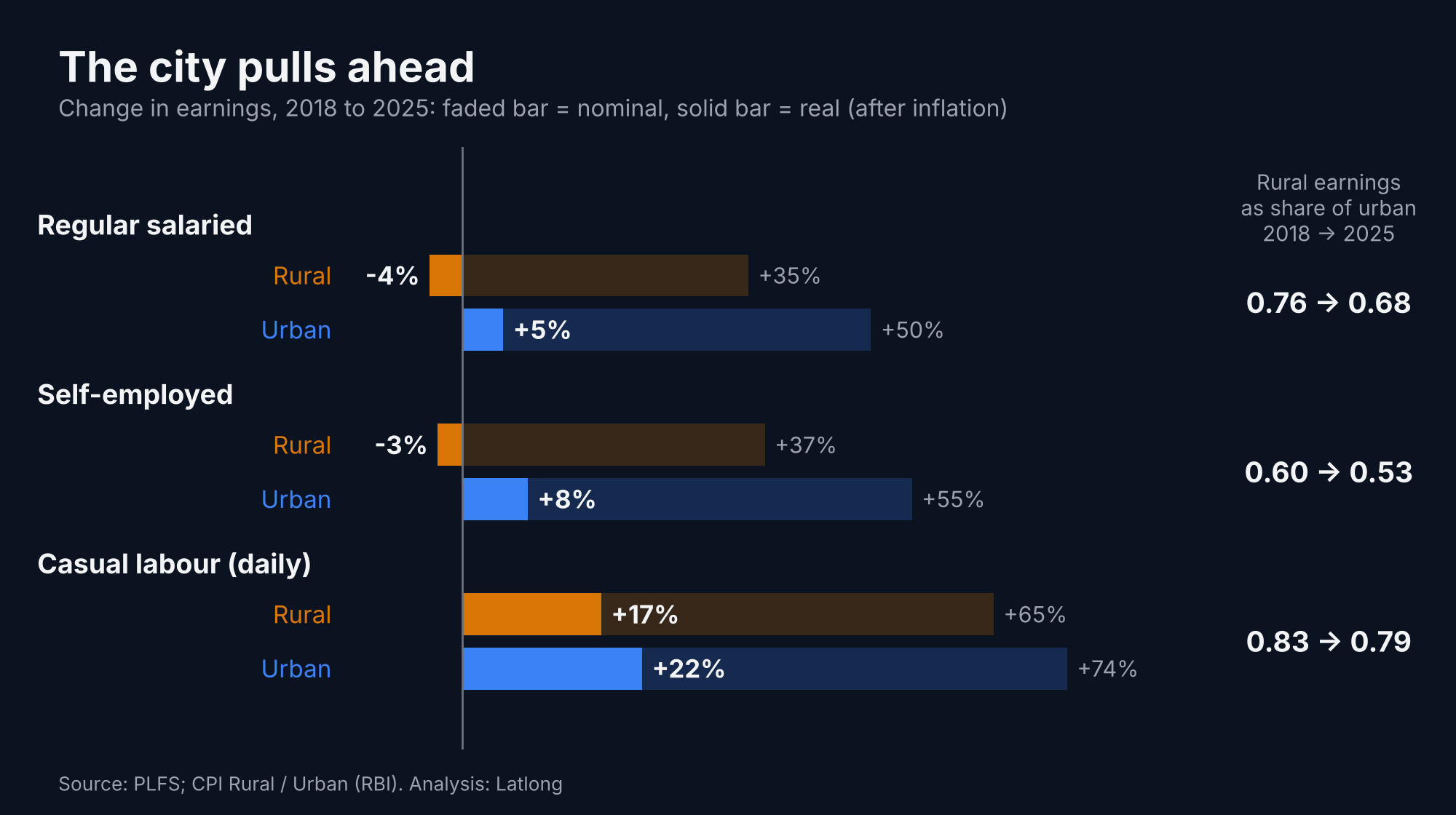
The economic incentive is plain. A worker weighing a village job against a town job in 2025 faces a wider gap than in 2018, whatever the work. It is no surprise that the pull towards cities, and towards the non-farm work they offer, has strengthened.
It also explains why the gains of self-employment are an urban story. The same label that pays better than a salary in Pune or Ludhiana still means a small income in a village. Maharashtra shows both sides most clearly: its urban self-employed overtook salaried workers, while its rural self-employed fell from 60% to 47% of urban earnings.
Meanwhile, the salary lost its premium
The naukri has not fared as well. In rupees, salaried pay rose 50% in urban India and 35% in rural India between 2018 and 2025. Prices rose 41% in rural India and 43% in urban India over the same period. After inflation, the urban salaried worker is 5% better off, while the rural salaried worker is 4% worse off.
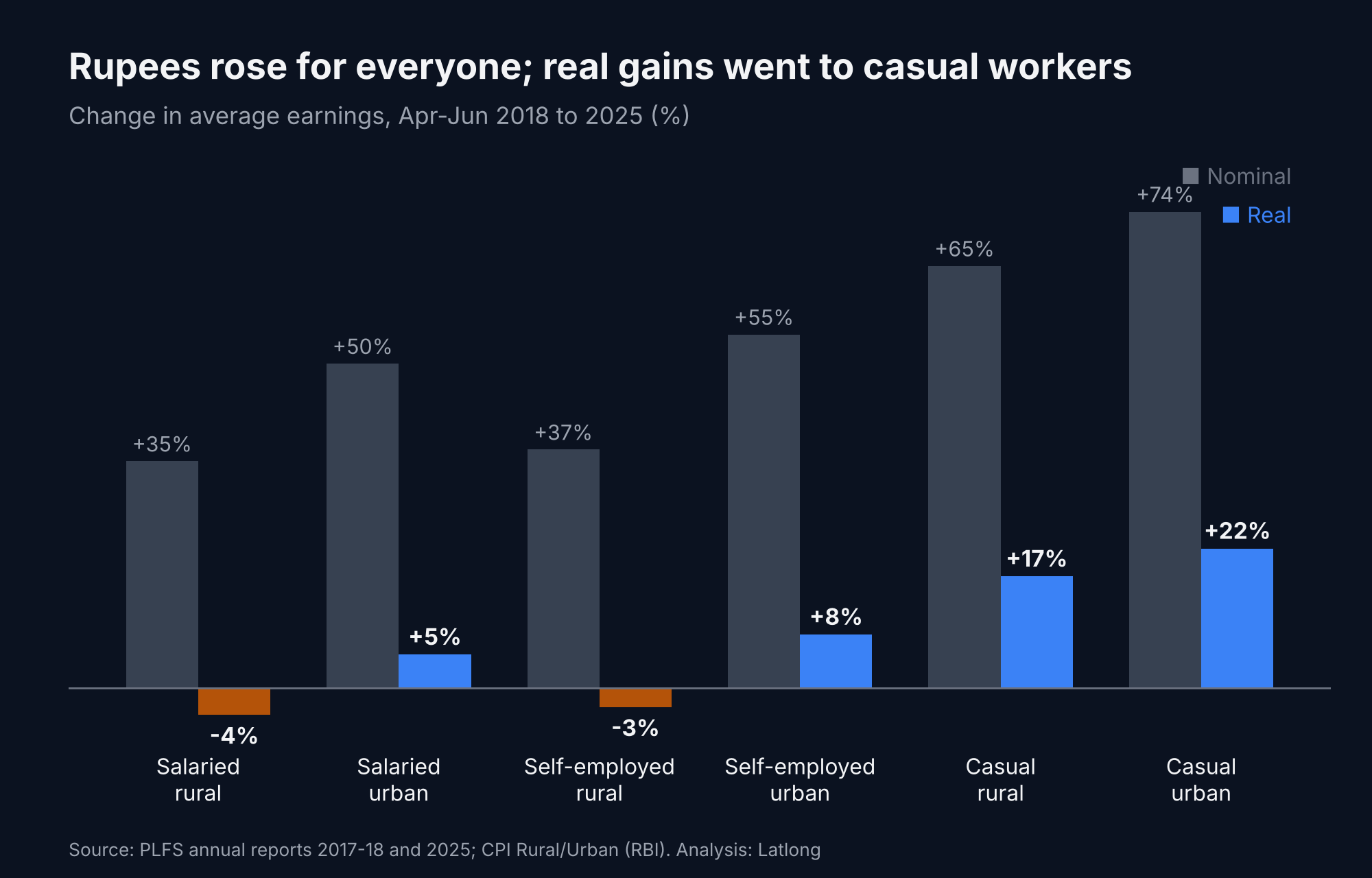
This is not for want of salaried jobs. Among rural men, the share in regular salaried work rose from 14% to 17%. But they joined at the bottom of the ladder, which is the most plausible reason the average rural salary fell even as more men drew one. More men got a naukri; it simply paid less than it used to.
And the casual labourer caught up
In 2017-18, one in four Indian workers was a casual labourer, hired by the day. By 2025, it dropped to one in five. The casual workforce shrank almost everywhere, fastest in West Bengal, Bihar, Madhya Pradesh, Andhra Pradesh, Kerala and Tamil Nadu. Only Assam, Uttarakhand and Delhi went the other way, that too marginally.
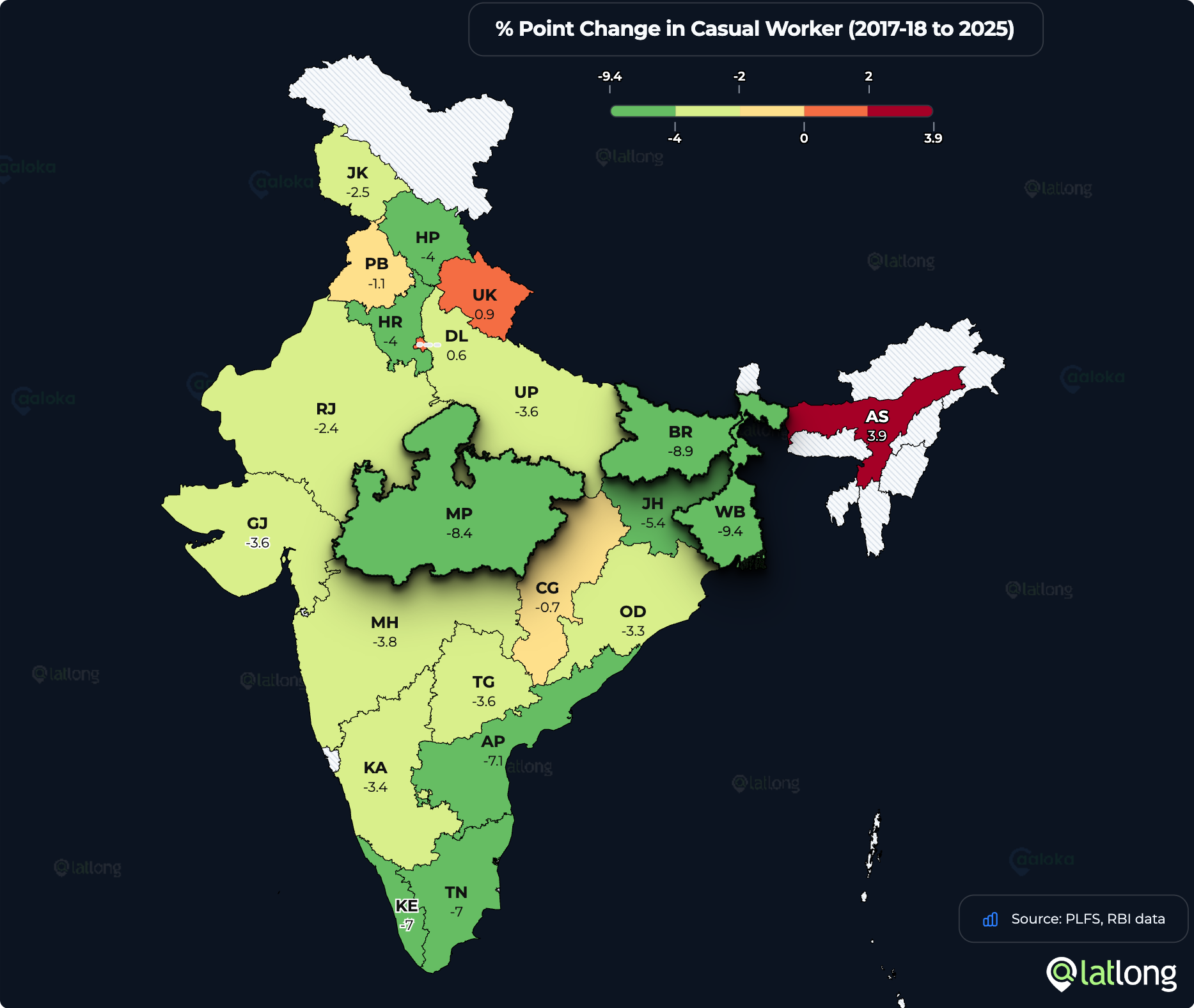
Those who remain are paid noticeably better. The real daily wage for casual work rose 17% in rural India and 22% in urban India, about four times the real gain of an urban salaried worker, while the rural salaried worker lost ground. In rural Karnataka it rose 38%, in Tamil Nadu 30%. This ties in with the anecdotal conversations with employers that it is extremely difficult to find casual workers and that their costs have gone up.
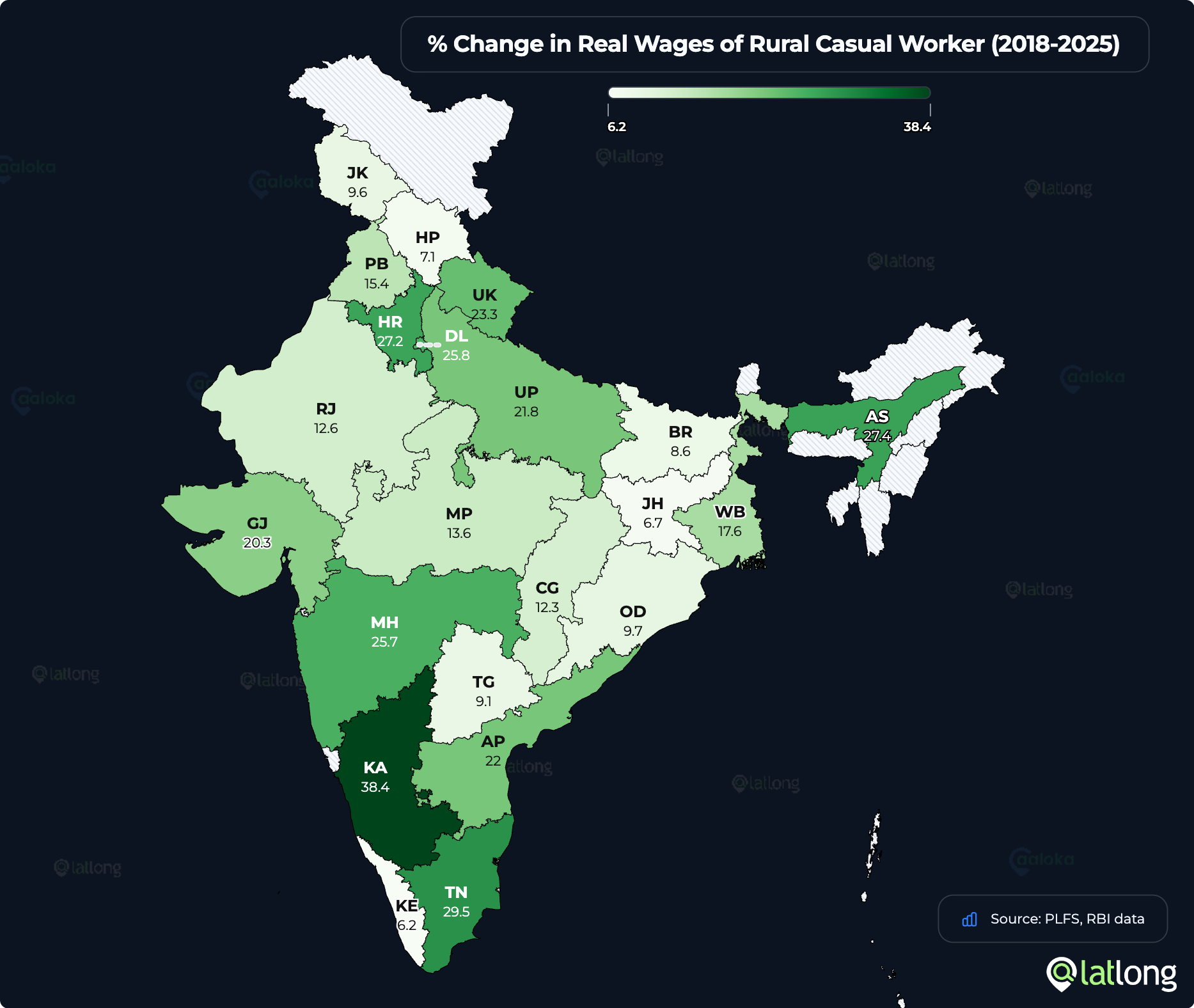
One cannot say from these numbers alone why. A smaller pool of casual workers, a construction boom and higher minimum wages may all have played a part. What one can say is that the distance between the bottom rung and the salaried rung has narrowed, and quickly.
What it means
- Self-employment can no longer be read only as distress. In Pune or Ludhiana, it can mean a better living than a desk job; in a Bihar village it often still means a small income. The same label hides both, and policy should stop treating it as one thing.
- Credit for small enterprise may be doing more work than we credit it with. The link with Mudra is suggestive, not proven, and deserves a proper study.
- "Creating regular jobs" is a weaker goal than it sounds. If new salaried jobs come in at the bottom of the scale, a rising salaried share can sit alongside falling average pay.
- The farm exit has a second act. Our earlier piece showed men leaving India's farms. This one suggests their destination is less obviously a salaried job than one assumes.
For two generations, the anecdotal ambition of the Indian parent was a naukri for the child. One wonders what that ambition becomes when the shop down the road pays better than the desk.
A note on the data: Earnings are PLFS averages by current weekly status, comparing April–June 2018 with calendar 2025. Shares of workers are by usual status, 2017-18 and 2025. Rural earnings are adjusted with CPI-Rural and urban earnings with CPI-Urban. Self-employed earnings are gross output minus expenses, as PLFS defines them. These are averages, not medians, and PLFS was redesigned for 2025. Delhi has very few rural residents, so its rural figures rest on a small sample and should be read with care.
Sources: PLFS Annual Reports 2017-18 and 2025 (MoSPI) · RBI, CPI monthly index · Economic Survey 2025-26, Table 4.3 · PIB, A decade of PM Mudra Yojana · Business Standard on the SBI Mudra report · Angel One on Mudra state shares
This article was first published on Narayana Bhatta’s Substack: https://pnbhatta.substack.com/p/more-indians-work-for-themselves


Put location to work.
See how latlong.ai products fit your team. Book a 30-minute walkthrough with our solutions team.