

Bihar Now Has More Stock Market Investors Than Delhi
In 2015, Delhi had 4x as many stock market investors as Bihar. Today, Bihar has more. 1 in 7 adult Indians is now a registered investor, and the newcomers are as likely to come from Muzaffarpur & Meerut as from Mumbai. The surprise is in the south, where richer states are slipping behind.
One in seven adults now invests in stocks
In September 2024, drawing on NSE's Market Pulse for August 2024, we wrote (also on X) that India's registered investor base had crossed 10 crore, about 10.3% of adults. NSE's Market Pulse for October 2026 now counts 13.66 crore unique investors as of 30 September 2026. Measured against the 2024 electoral rolls, that is 13.9% of adults: 1 in 7.
In March 2015, the figure was 2.2%, or 1 in 45. It reached 6.5% by March 2020; the rush of first-time investors post-pandemic took it to 11.5% by March 2025. Penetration of the stock market has continued apace and has risen more than 6× in 11.5 years.
By the standards of comparable economies, that is a high number. Among large emerging markets, only China is ahead:
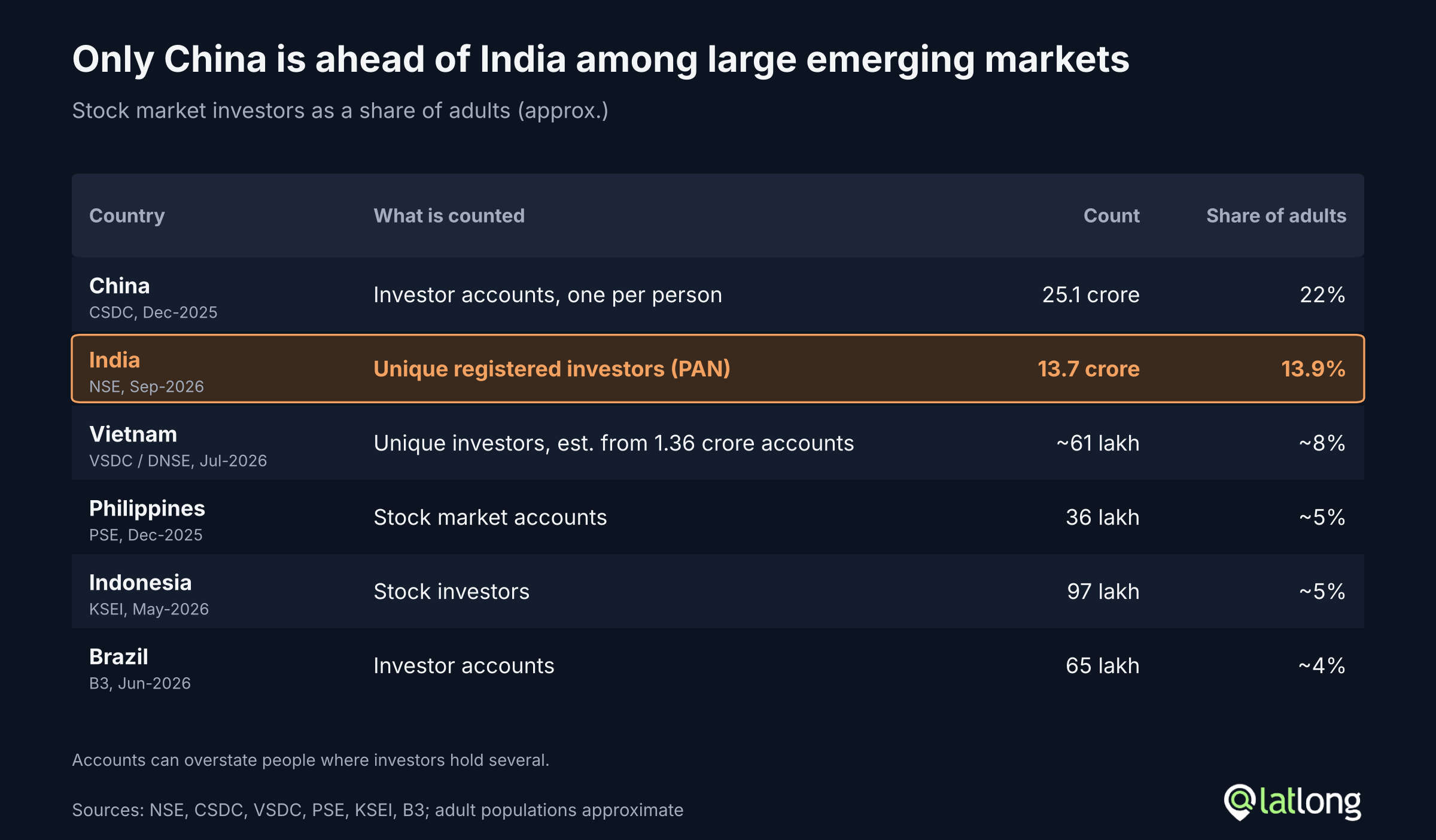
India has roughly three times the penetration of Indonesia, Brazil and the Philippines.
While the national number is striking as it is, the more interesting story is that the geography of the Indian investor has changed and continues to change quite rapidly.
Where the 12 crore new investors came from
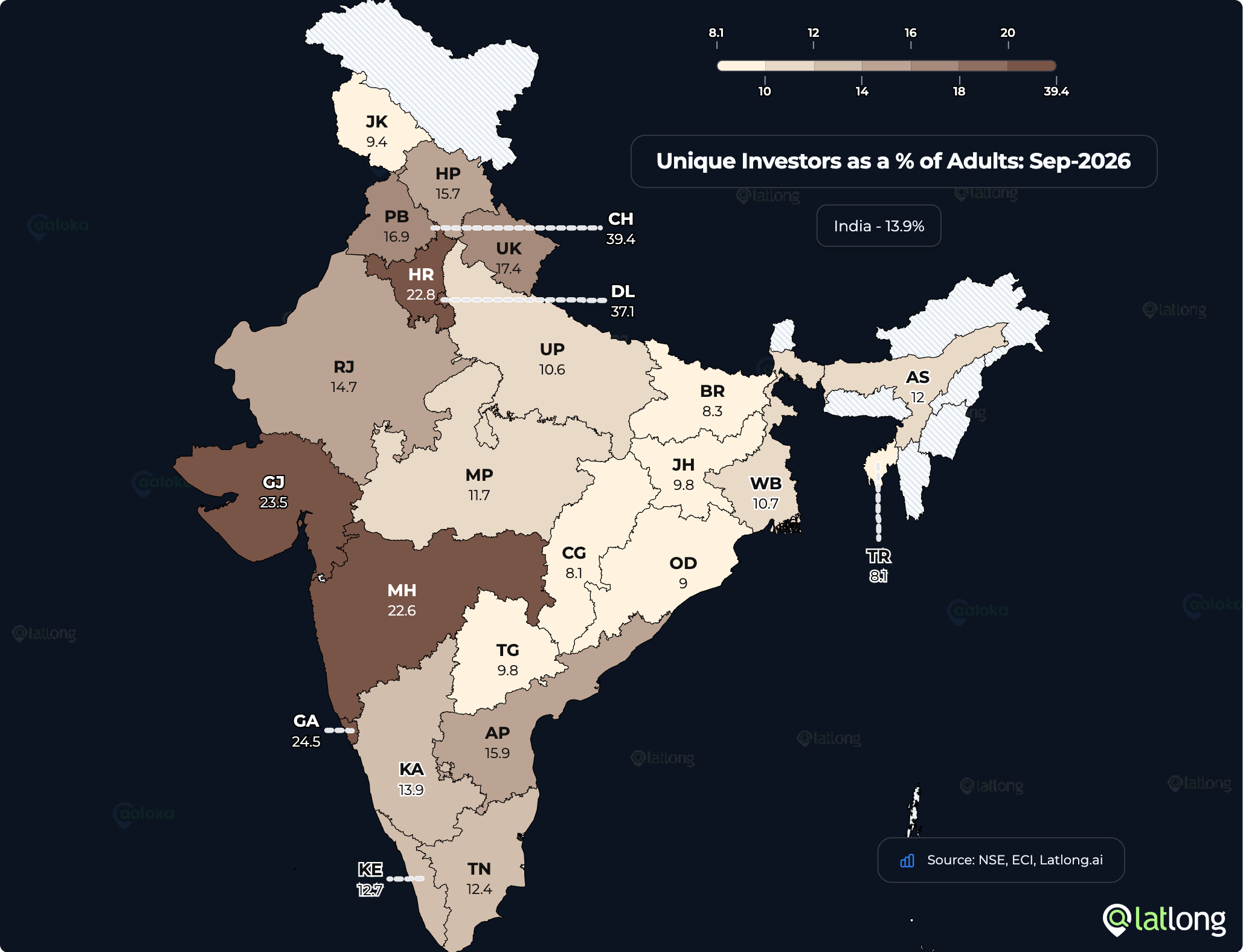
Between Mar-2015 & Sep-2026, India added 11.86 crore registered investors. Penetration rates flatter states that start from a low base; absolute numbers say plainly where the new investors are.
Maharashtra still leads, having added 1.75 crore investors. Uttar Pradesh follows with 1.51 crore, then Gujarat (96 lakh), Rajasthan (72 lakh) and West Bengal (69 lakh) follow. 10 states account for 73% of the addition. Bihar ranks eighth, with 61 lakh addition.
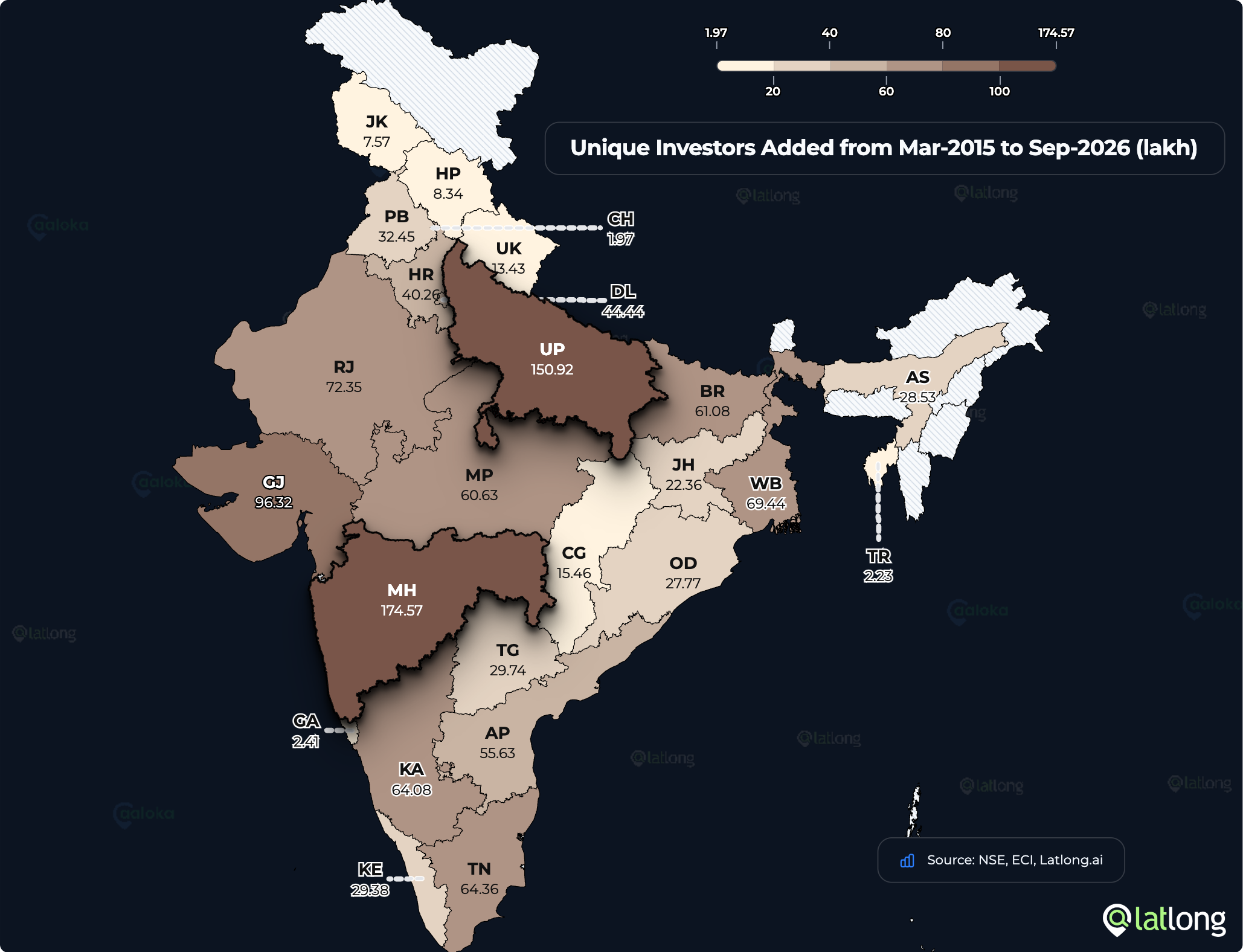
The lead changed hands along the way. Maharashtra supplied 18% of new investors between 2015 & 2020, 13.5% between 2020 & 2025, and 11% since. UP's share moved the other way: 10%, 14%, then 15% in same timeframes. Since 2020, UP has added more investors than any other state.
Another way to look at the data is to see if each region added investors in proportion to its adults:
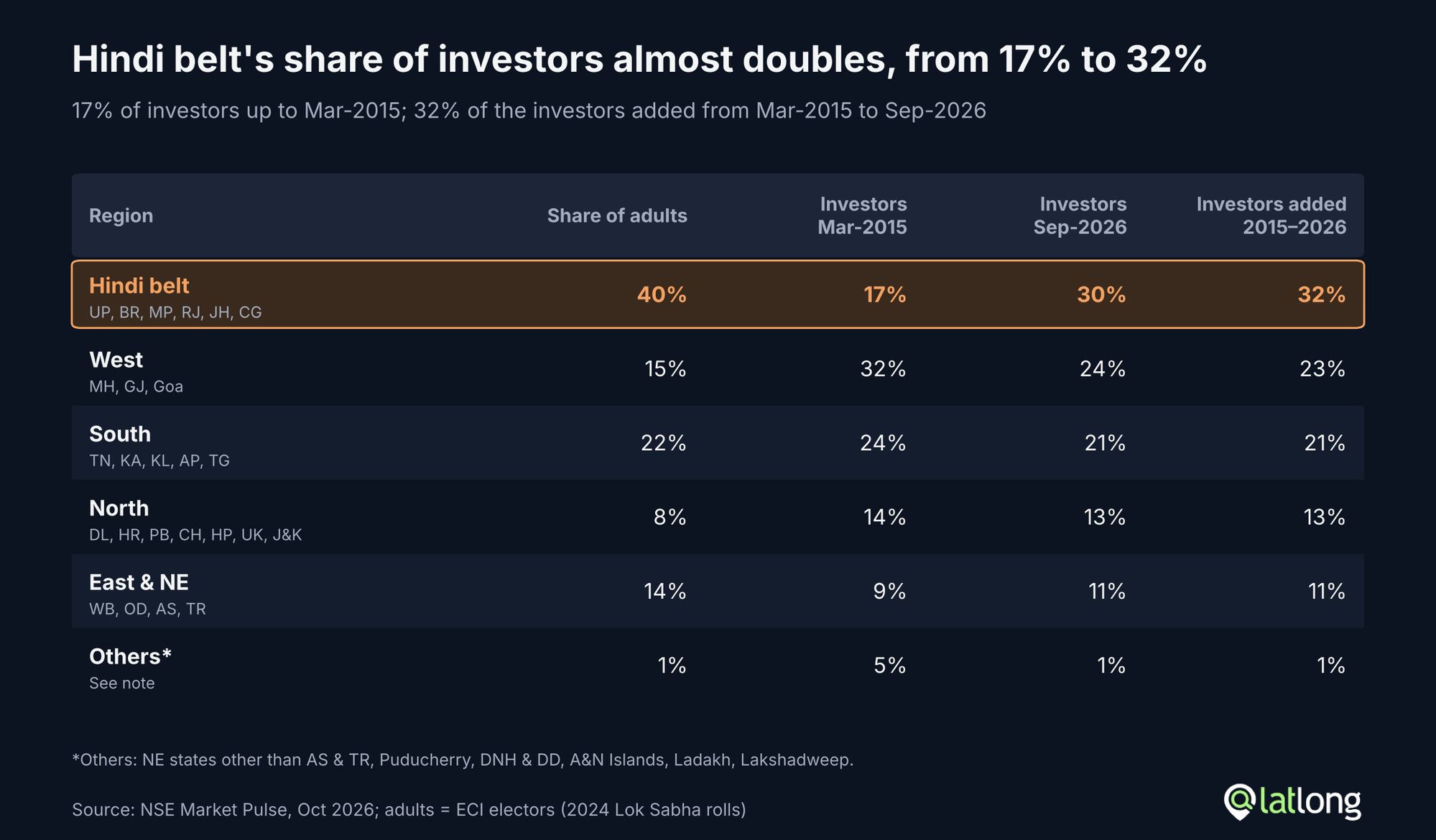
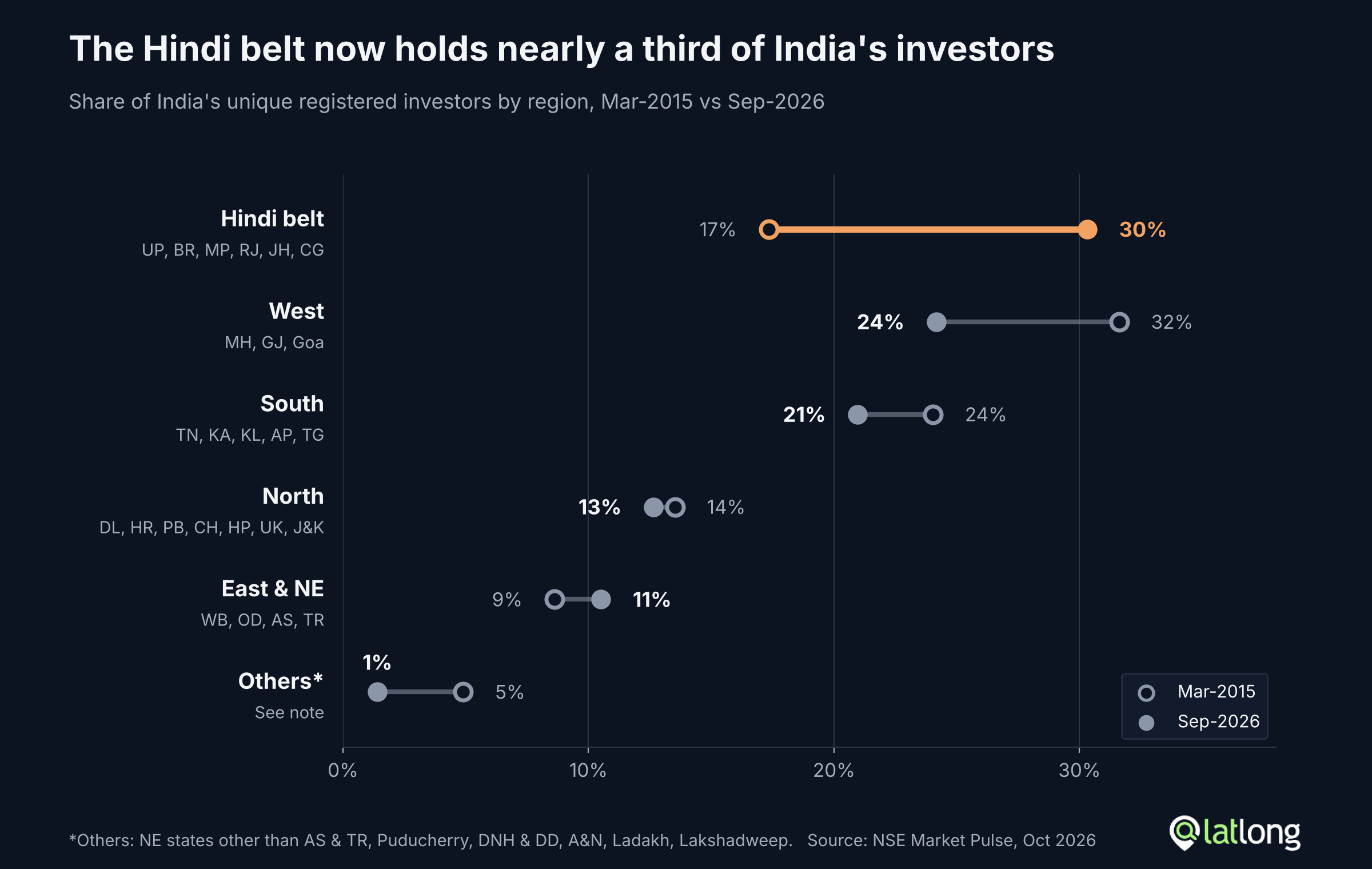
The West and the North still punch well above their weight. The Hindi belt remains under its weight, but its share of investors has risen from 17% to 30%. The South is the only major region that added investors at less than both its share of adults and its share of the 2015 base; the piece returns to this a little later.
Dalal Street reaches Patna & Lucknow
In March 2015, Delhi had 12.0 lakh registered investors and Bihar had 2.9 lakh. Delhi, with a fifth of Bihar's adults, had 4.1× its investors. Somewhere between 2020 and 2025, the lines crossed. By March 2025 Bihar had 50.9 lakh investors to Delhi's 49.2 lakh, and by September 2026 the lead had widened to 64.0 lakh vs 56.4 lakh.
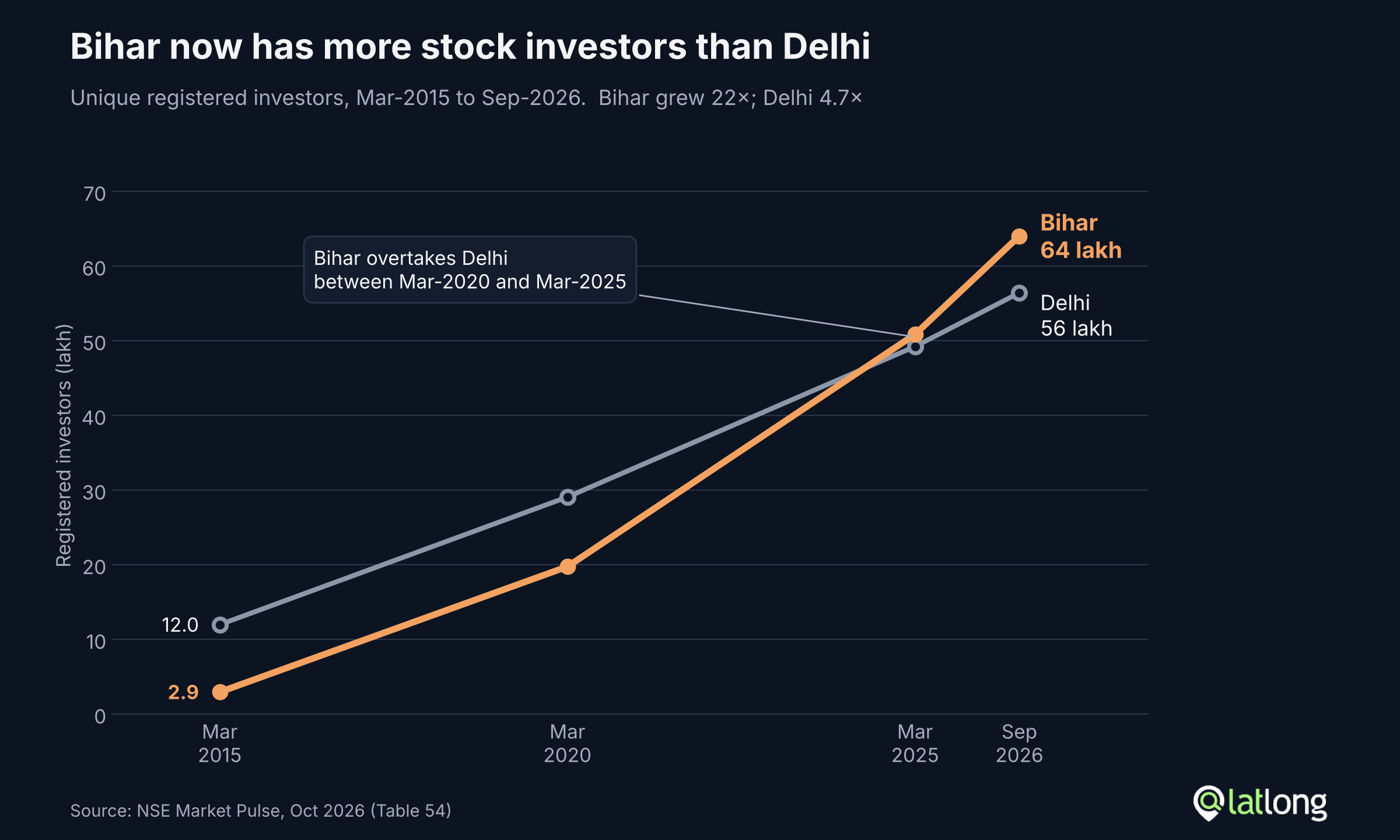
Bihar's investor count has grown 22× since Mar-2015, against 4.7× for Delhi and 7.6× for India. The share of Bihar's adults who invest has gone from 0.5% to 8.3%, an 18× rise. In the eighteen months since March 2025 alone, the state added 13.2 lakh investors; nearly as many as Karnataka and almost twice as many as Delhi.
However, only one in twelve adults in Bihar invests, against one in three in Delhi, and Bihar still sits near the bottom of the table. But the direction is unmistakable, and the pace is among the fastest in the country.
Uttar Pradesh is the larger engine. UP added 35.1 lakh investors in the 18 months from Mar-2025 to Sep-2026: about one of every seven new investors in India. In Mar-2015, Maharashtra had 2.9× as many investors as UP; today it has 1.3×. At this rate, probability is quite high that UP becomes India's largest investor state before the decade is out.
Gujarat, meanwhile, shows what broad-based depth looks like. At 23.5% of adults, it has the highest penetration of any large state. And its investors are not confined to Ahmedabad. 4 of the Top-10 districts, in NSE's latest list of districts adding most investors in Sep-2026, are in Gujarat: Ahmedabad (23,900), Surat (19,200), Bhavnagar (15,000) & Rajkot (12,700). Together they added 70,800 investors in the month, more than the 4 districts of Mumbai (Mumbai City, Mumbai Suburban, Thane, Ratnagiri) & Pune combined (57,200).
The gap between states is closing fast
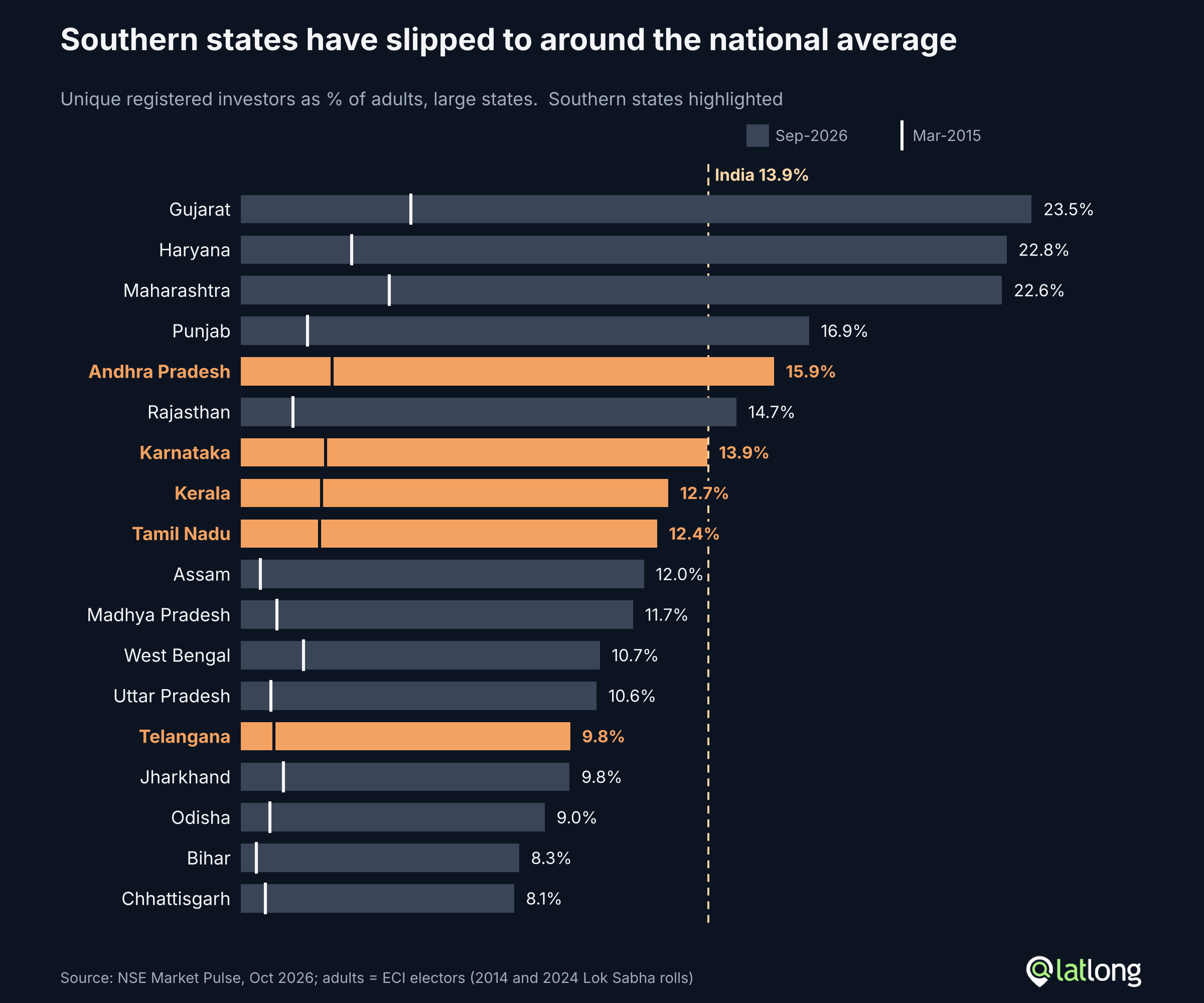
In 2015, Gujarat's penetration of 5.1% was 11× Bihar's 0.5%. Today the most invested large state, still Gujarat at 23.5%, is under 3× the least invested, Chhattisgarh at 8.1%. Every large state has at least quadrupled its penetration since 2015, while the laggards of 2015 — Bihar, UP, Madhya Pradesh, Odisha, Chhattisgarh — have risen ten- to eighteen-fold (Figure 5, in the next section).
Assam’s is perhaps the most remarkable story. In March 2015 it had 1.09 lakh registered investors, 0.6% of its adults, and ranked 23rd of the 25 states and union territories NSE reports separately. Today it has 29.6 lakh: a 27× rise in investors and a 21× rise in penetration, to 12.0%. That puts Assam at similar level as Kerala (12.7%) & Tamil Nadu (12.4%), states that began the period with four times its penetration and are considerably richer. It is now ahead of Madhya Pradesh, West Bengal and Uttar Pradesh, and its share of India's investors has risen from 0.6% to 2.2%.
Two hill states have climbed too. Uttarakhand (17.4%) and Himachal Pradesh (15.7%) have each risen six places, into the top ten. West Bengal and Jharkhand have each slipped five.
At the very top, growth is slowing. Chandigarh's investor count rose just 6% in the last eighteen months and Delhi's 15%, against 21% for India and 26–27% for Bihar and UP. With a third of their adults already registered, the leaders appear to have finished the easy part.
Southern India loses its lead
In our 2024 piece, one noted that the top ten states by penetration had no representation from the richer states in the southern peninsula. Two years on, the gap has widened. Karnataka (13.9%), Kerala (12.7%) and Tamil Nadu (12.4%) are at or below the national average, and each has slipped four places since 2015. Andhra Pradesh, at 15.9%, is the lone southern state in the top ten. Together the five southern states stand at 13.1%, against 23% for the West and for the North.
The South was an early mover: in 2015 it held 24% of India's investors, well ahead of the Hindi belt's 17%, and it is richer. Its slowdown needs explaining.
NSE's district data offers a clue. Of the ten districts that added the most investors in September 2026, only one is in southern India: Bengaluru, with 17,300. There is no Chennai, no Hyderabad, no Kochi. Gujarat alone has four districts on the list, and Saurashtra two of them.
One hypothesis is that southern prosperity has not spread beyond a few cities. Karnataka's own Economic Survey makes the case starkly. In 2024-25, Bengaluru Urban's per capita income was ₹8.56 lakh & Kalaburagi's was ₹1.44 lakh; a gap of nearly 6×. In 1970-71 the two districts were almost level, at ₹699 and ₹622. Only five of the state's 31 districts (Bengaluru Urban, Dakshina Kannada, Udupi, Chikkamagaluru & Shivamogga), are above the state average of ₹3.86 lakh. Eight are below ₹2 lakh, and all eight lie in the northern part of Karnataka: Kalaburagi, Yadagir, Raichur, Koppal, Bidar, Belagavi, Vijayapura & Vijayanagara.
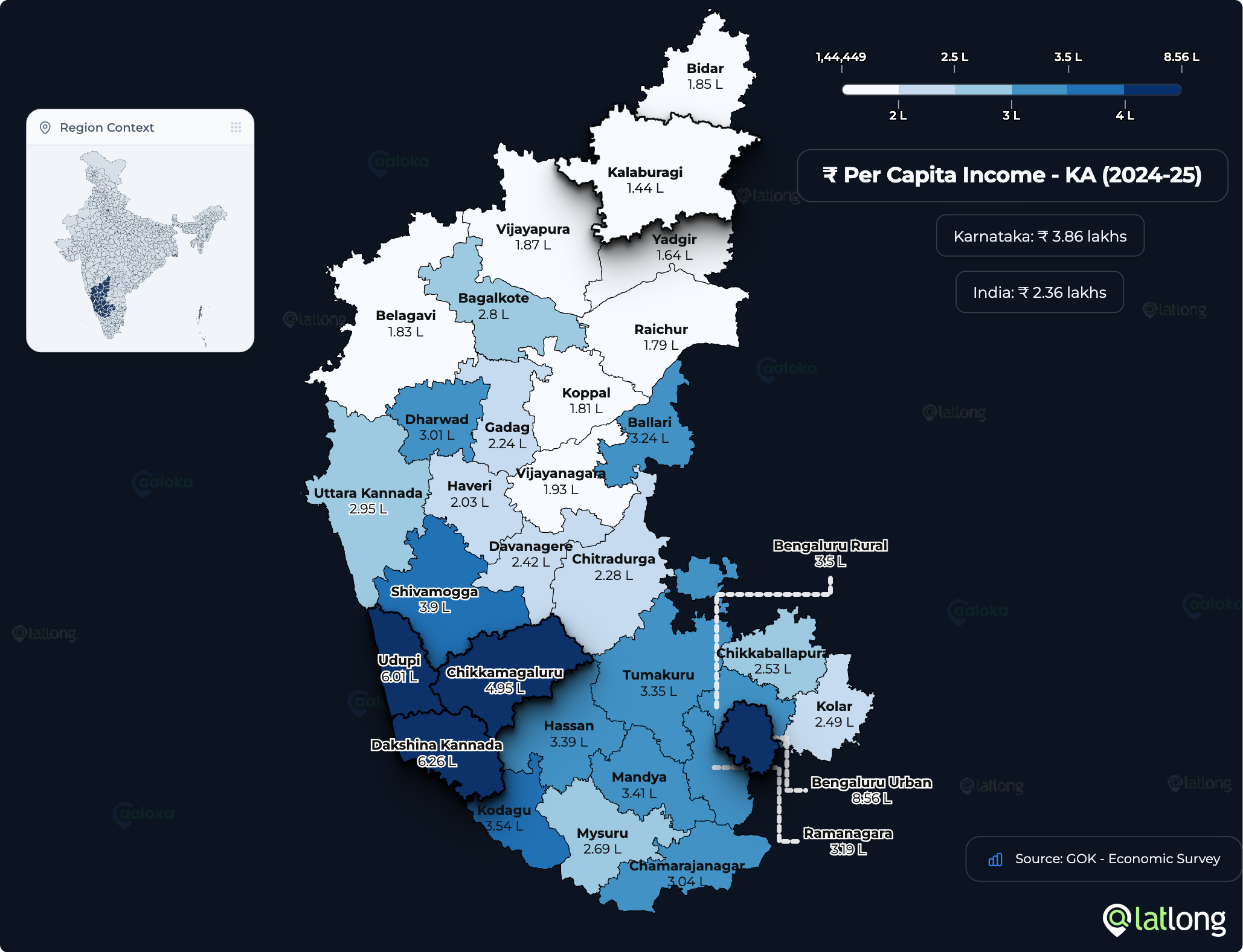
Median per capita income of Kalyana Karnataka district at ₹1.81 lakh, is less than half the state average of ₹3.86 lakh. Bengaluru Urban alone produces 40% of the state's output, and Kalaburagi's income has even dipped slightly in nominal terms (ThePrint, Asianet Newsable).
If the South's early investors came from a handful of metros, the state averages would stall once those metros filled up, unless the likes of Kalaburagi, Raichur & Yadagir followed. The heartland's growth looks different: UP is consistently among the top states for new registrations, yet no UP district outside the NCR makes NSE's top ten. Its investors are coming from many districts at once.
Testing this properly needs NSE's full district-level data, which is not public; the top-ten list is a glimpse, not the picture. RBI's district-wise bank deposits and AMFI's "beyond top 30 cities" share of mutual fund assets offer partial proxies.
Three other explanations are plausible, and one suspects the answer is a mix:
- Demography. New investors skew young. The South's adults are older, and fewer people turn 18 there each year than in Bihar or UP.
- Penetration of Brokerage Apps. Demography, coupled with explosion in app usage since the pandemic, making stock markets more accessible to a huge swath of population.
- Other ways of saving. Gold, chit funds & real estate as preferred avenues for investing in some parts of the country.
With more granular data from NSE, one hopes to be able to get better answers.
Beyond the ballot box
In 2024, we argued that investors had become a significant chunk of voters. That is now true well beyond the metros.
An average Lok Sabha constituency in Bihar has about 19 lakh electors; at 8.3%, that is roughly 1.6 lakh registered investors per seat, more than many winning margins. Capital gains tax, securities transaction tax and SEBI's rules on derivatives trading now touch voters in Guwahati, Indore and Bhavnagar, not just in Mumbai’s Malabar Hill or Bengaluru’s Indiranagara.
The implications for business are larger.
- Brokers and fund houses. The next five crore investors will come mostly from the Hindi belt, the East and the North-East. Serving them means content in Hindi, Bhojpuri and Assamese, assisted onboarding, small-ticket SIPs and a presence in district headquarters and in some of the taluk headquarters too.
- Banks, NBFCs and insurers. A registered investor already has a PAN, a completed KYC and a digital trail. In Bihar, UP and Assam, that is a pre-qualified customer base for loans against securities, insurance and pensions.
- Consumer companies. A market correction now dents household balance sheets in Begusarai & Kanpur as much as in Ahmedabad. Demand forecasts for two-wheelers, durables and housing will need to allow for a wealth effect that is no longer confined to the metros.
- Companies raising capital. Retail demand for IPOs, SME issues included, now comes from new geographies. Investor relations, AGMs and disclosures will need to reach shareholders who read in Hindi, Gujarati and Bengali.
Regulators face a harder task. The new investor is young, often the first in the family to invest, and lives where registered advisers are few. SEBI's own study found that about nine in ten individual traders in equity derivatives lost money between FY22 & FY24. Investor education and grievance redressal will have to follow the investor beyond India-1 Alpa & India-1 to India-2. Also, the young will be more in-tune with ease of use and any regulation seen as a ‘speed-breaker’ (like complicated KYC) will mean several thousand posts on social media.
For anyone planning on the ground, these are, finally, map questions: which districts to open the next branch in, which pin codes to target, where an advisory desk has higher probability of success. State averages hide most of the answer. District, pin-code and sub pin-code data hold it.
The investor has become a constituency: for the politician, the marketer and the regulator alike. Dalal Street, it turns out, now runs through Patna & Meerut, Bhavnagar & Guwahati. Hopefully, soon it will find its way to Kalaburagi!
A note on method
- Investor counts are NSE's unique registered investors by state, from Table 54 of NSE Market Pulse, October 2026; the latest figures are as of 30 September 2026.
- District figures are new registrations in September 2026 from Figure 239 of the same report.
- "Adults" are electors on the ECI rolls for the 2014, 2019 and 2024 Lok Sabha elections, matched to March 2015, 2020 and 2025; September 2026 uses the 2024 rolls.
- Registered investors may not necessarily be active investors.
- Bihar's 2025 roll revision brought its electors down to about 7.4 crore; on that base Bihar's penetration would be slightly higher at about 8.6%.
- Census 2027 will reset these denominators.
- International comparisons use approximate adult populations (18+), using Claude for obtaining the data and each market's own definition of an investor.
- Karnataka's district per capita incomes are for 2024-25, at current prices, from Appendix 1.6 of the Economic Survey of Karnataka 2025-26 (provisional), covering 31 districts.
Sources
- NSE Market Pulse, across editions (and multiple others)
- Latlong.ai, Democratization of Stock Markets in India, September 2024: LinkedIn, X
- Election Commission of India, electors by state, Lok Sabha 2014, 2019 and 2024
- Government of Karnataka, Economic Survey of Karnataka 2025-26
- ThePrint: Karnataka’s Economic Survey lays bare a 500% income gulf
- Asianet Newsable: Kalaburagi per capita income
- KSEI, Statistik Publik, May 2026 (Indonesia)
- Forbes Brasil, July 2026 (Brazil)
- Viet Nam News, August 2026 (Vietnam)
- Daily Tribune, September 2026 (Philippines)
- PulseAugur, summarising CSDC’s 2025 annual report (China)
- SEBI, study of profit and loss of individual traders in equity F&O, FY22–FY24
This blog was first published at: https://pnbhatta.substack.com/p/bihar-now-has-more-stock-market-investors


Put location to work.
See how latlong.ai products fit your team. Book a 30-minute walkthrough with our solutions team.