

The Distance Between a Dealer and a Borrower Is Now a Risk Signal
How Latlong.ai helped a leading captive vehicle finance company in India automate geo-limit validation.
A customer walks into a dealership, chooses a vehicle, completes the paperwork and submits a KYC address. On the surface, it looks like a regular loan application. But for a captive finance arm, one question can quietly change the risk profile of the case: Is the borrower actually within the dealer’s permitted catchment?
That question becomes harder in India, where addresses can be incomplete, inconsistently written, and locally understood but digitally ambiguous. This is where a geo-limit validation API, built on accurate address geocoding for India, turns a manual judgement call into an automated, auditable check.
Vehicle Finance in India is Growing and so is Catchment Risk
India’s vehicle financing market is expanding fast, and the pressure is moving from simply acquiring borrowers to acquiring them intelligently. IMARC Group estimates the India vehicle financing market at USD 28.47 billion in 2025, projected to reach USD 52.01 billion by 2034.
Regulation is pushing the same way. The RBI (Digital Lending) Directions, 2025 cover the lending journey from customer acquisition and underwriting to recovery, which makes consistent, documented origination checks more valuable for banks and NBFCs.
Catchment Risk Hiding Inside Free-Text Addresses
A large vehicle manufacturer in India had started its captive financing journey. As loan volumes moved into the Loan Origination System (LOS), the risk team needed a simple, real-time way to validate whether a customer was within the lender-defined geo-limit of the sourcing dealer.
The business rule was clear: compare the customer’s KYC address with the assigned dealership and return whether the case is within or outside the geo-limit.
How the geo-limit validation API works inside the LOS
- The customer applies for a vehicle loan through the lender’s LOS.
- The LOS captures the sourcing dealer and the customer’s KYC address.
- The LOS calls the Latlong.ai API with the dealer identifier and address.
- Latlong.ai validates the dealer against the dealer master.
- The customer address is geocoded into latitude and longitude.
- The platform calculates the distance between the dealer and the customer.
- The distance is compared with the dealer’s configured geo-limit, and a status is returned.
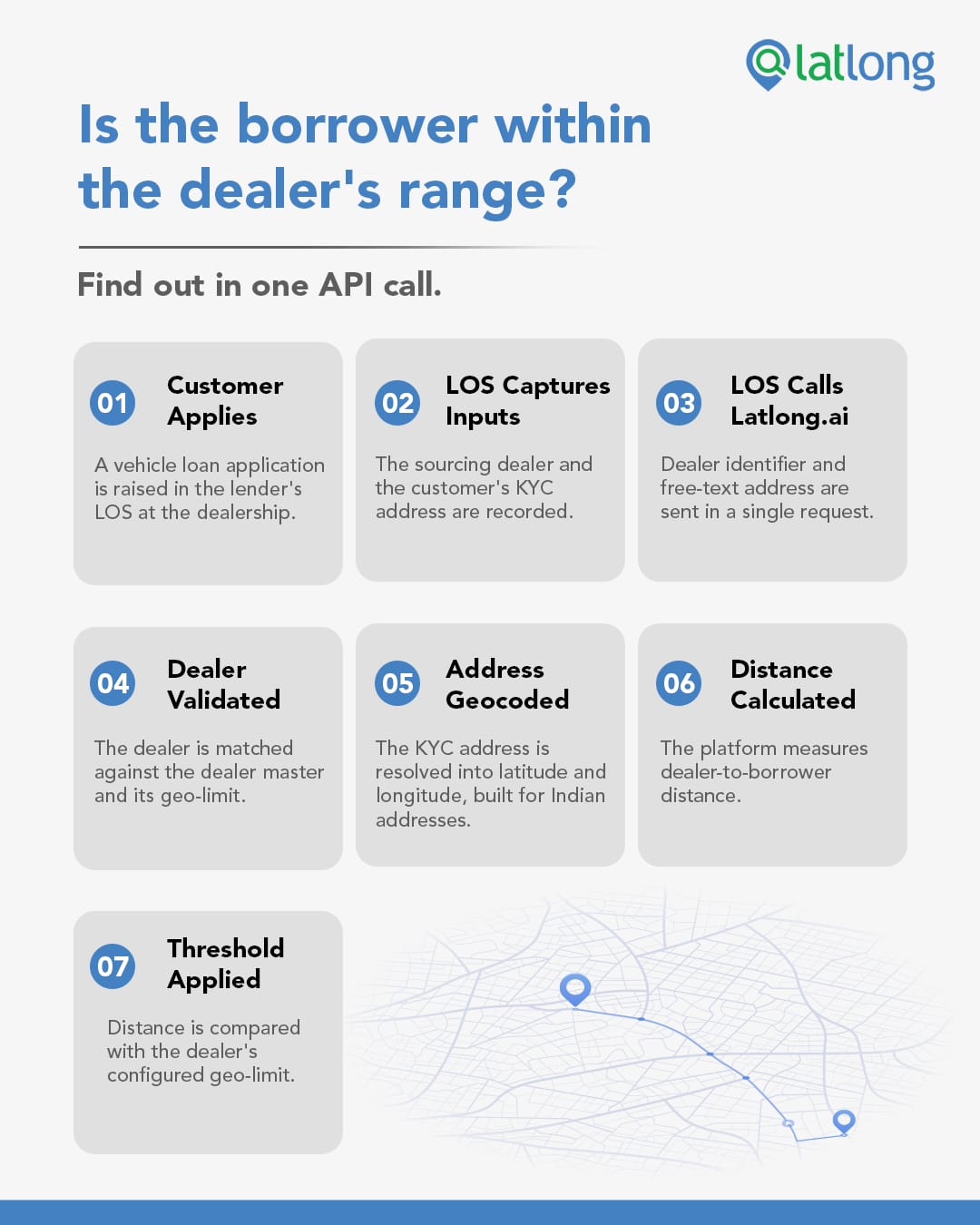
At the heart of the solution is a spatial comparison loop: normalise the dealer, geocode the borrower, calculate distance, apply threshold logic, and return a machine-readable status to the LOS.
Accuracy of step 5 decides everything downstream. In a 2023 benchmark verified by IIT Kanpur’s National Centre for Geodesy, Latlong’s geocoding API was found twice as accurate as Google Maps for Indian addresses; a later in-house benchmark with a strong rural focus put Latlong’s average error at 297 metres against 1,280 metres for Google Maps.
What the Lender Gained: Operational Confidence, Not Just Integration
A rule that earlier depended on local knowledge or manual verification now runs inside the credit workflow. The system flags out-of-geo-limit applications early, routes exceptions consistently, and gives risk teams a clearer audit trail.
- Reduced Manual Checks: Operations teams no longer validate customer–dealer proximity case by case.
- Consistent Policy Enforcement: Dealer-specific limits apply uniformly across channels.
- Better Exception Handling: Dealer not found, address failure or missing master data are routed with clear response logic.
- Stronger Auditability: Application IDs, dealer IDs and distance outputs create traceable decision records.
The same dealer master and distance logic can later feed territory planning and white space analysis for dealer network decisions.
Why Location Intelligence Matters Beyond One Lender
As vehicle finance becomes more digital, location will become a stronger decision variable. It will influence dealer strategy, risk segmentation, collection planning, fraud detection and customer service design.
Latlong.ai’s broader philosophy is that India needs mapping technology designed around Indian ground realities: multilingual place names, fuzzy locality boundaries, uneven data quality and fast-changing urban–rural edges. That thinking runs across its work for BFSI teams and automobile OEMs and dealers.
For captive finance companies, this opens a practical path: keep the credit workflow familiar, but enrich it with precise geography. The lender does not need to replace the LOS. It needs a reliable location intelligence layer that can answer one deceptively simple question in milliseconds: how far is this borrower from this dealer?
Want to run geo-limit checks inside your LOS?
Talk to the Latlong.ai team or try the geocoding API in the playground.
Frequently asked questions
What is geo-limit validation in vehicle finance?
Geo-limit validation checks whether a borrower’s KYC address falls within the distance a lender allows from the sourcing dealer. If the borrower is outside that catchment, the application is flagged for review before credit decisioning.
Why does the distance between a dealer and a borrower matter for credit risk?
Borrowers far outside a dealer’s normal catchment can signal sourcing irregularities, address misrepresentation or higher collection costs. Checking distance at origination helps captive lenders enforce dealer policy and spot unusual cases early.
How does a geo-limit validation API integrate with a loan origination system?
The LOS sends the dealer ID and the customer address in an API call. The API validates the dealer, geocodes the address, calculates the distance and returns a within-limit or outside-limit status, so the existing LOS workflow stays unchanged.
Why is geocoding Indian addresses difficult?
Indian addresses are often landmark-based, multilingual, incomplete or inconsistently spelled, especially in rural areas. A geocoder built for Indian address patterns, such as Latlong Maps, resolves these to accurate coordinates more reliably than global tools.
Can each dealer have a different geo-limit?
Yes. Limits are configured per dealer in the dealer master, so an urban dealership can use a tighter radius than a rural one and the rule is applied uniformly across channels.
What happens if the dealer is not found or the address cannot be geocoded?
The API returns a clear exception status, such as dealer not found or address failure. The LOS can route these cases to manual review instead of auto-approving or auto-rejecting them.
Is geo-limit validation only useful for captive finance companies?
No. Banks, NBFCs and two-wheeler or commercial vehicle lenders that source loans through dealers can use the same check. See how Latlong.ai supports BFSI teams.
Put location to work.
See how latlong.ai products fit your team. Book a 30-minute walkthrough with our solutions team.